

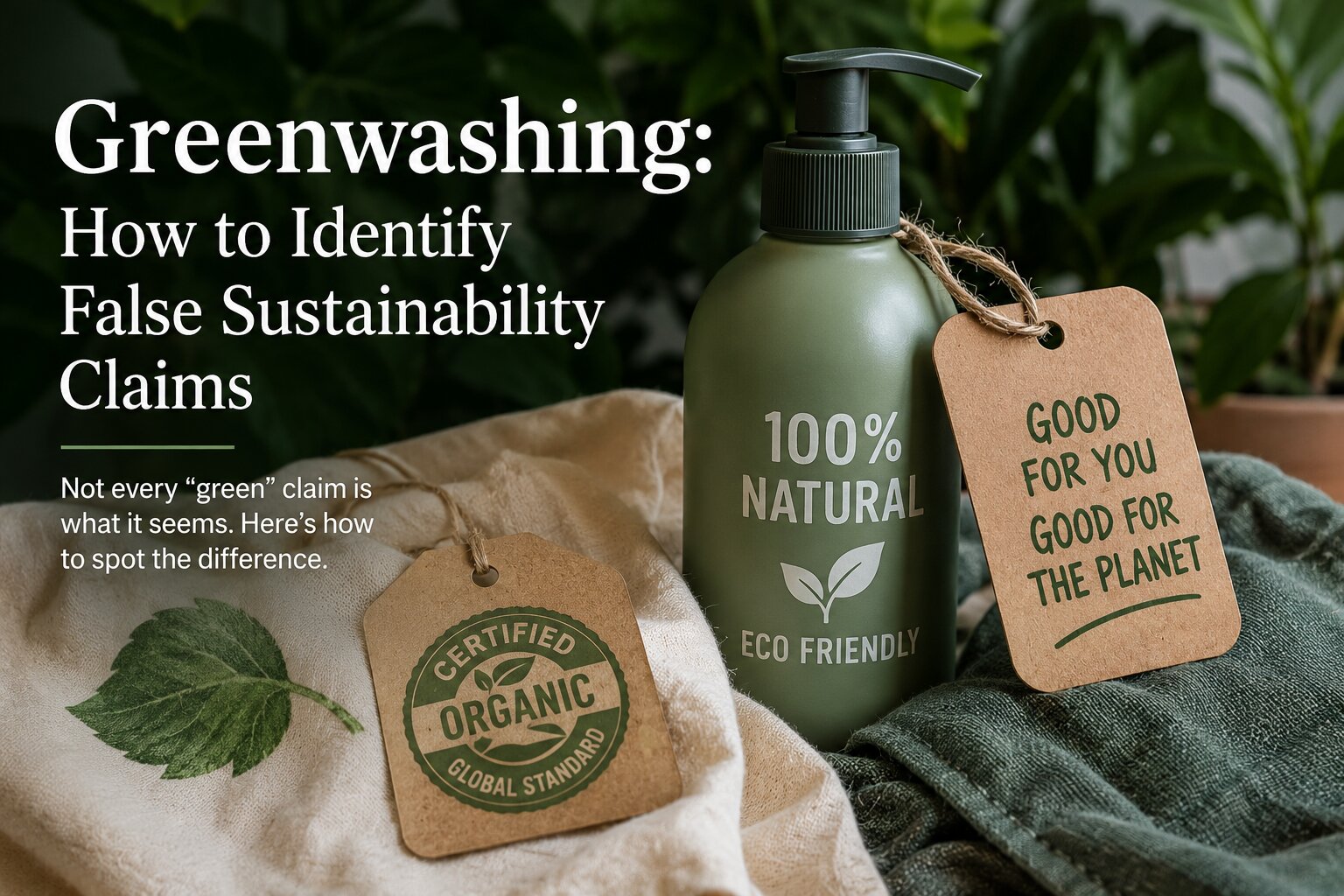

Somewhere in almost every sustainability audit I’ve ever run, there’s a moment where I have to tell a marketing team that a claim they’ve been using for years, something they genuinely believe is true, doesn’t actually hold up when you ask “compared to what, and how do you know?” That moment is never comfortable. It’s also, in my experience, the single fastest way to explain what greenwashing actually is.
Greenwashing is when a company makes an environmental claim that’s false, exaggerated, vague, or simply unverifiable, in order to look more sustainable than it is. You can usually spot it by watching for the same handful of tells: unproven buzzwords like “eco-friendly,” a claim with no evidence behind it, a self-invented label dressed up to look official, or a green feature that’s doing a lot of work to distract from a bigger environmental problem sitting right next to it.
This isn’t a new phenomenon, and it isn’t going away on its own. What’s changed, and changed quickly, is that regulators in the EU, UK, and Australia are now backing their skepticism with real fines. So the old habit of “checking for proof, specificity, and independent verification” has gone from a nice-to-have to something companies genuinely can’t afford to skip anymore.
What Greenwashing Actually Is
Picture a bottle of dish soap. Leafy green label, a photo of a forest, the words “naturally derived” in friendly cursive script. It feels responsible just sitting on the shelf. But what does “naturally derived” actually certify? Nine times out of ten, when I’ve pushed a client to answer that question honestly, the answer is: nothing. That gap between the impression a label gives and the evidence behind it is greenwashing, in a sentence.
Greenwashing is the practice of conveying a false or exaggerated impression of environmental responsibility. As Oxford researcher Dr. Aoife Brophy has put it, the deception can be about a single product’s green credentials, or about a company’s overall environmental performance. Either way, the pattern is the same: the marketing budget spent on looking green outweighs the actual work of being green.
The term has a genuinely good origin story. Environmentalist Jay Westerveld coined “greenwashing” in a 1986 essay after he noticed hotels urging guests to reuse their towels “to save the environment,” while the same hotels were busy expanding in ways that had nothing to do with saving anything. The towel card was a laundry-cost decision wearing an ecology costume. Almost four decades on, I still see some version of that exact trick, dressing up a cost-saving or convenience decision as an environmental one, in nearly every industry I work with, from fashion to food to finance to aviation.
Worth separating out early: some greenwashing is deliberate marketing spin, and some is genuinely accidental, the result of sloppy wording, an out-of-date data point, or a claim that got copied from last year’s report without anyone re-checking it. I’ve seen both plenty of times. Both mislead people either way, and under the newer rules, both can carry consequences regardless of intent.
Why It Matters More Than a Marketing Nitpick
Greenwashing isn’t a victimless exaggeration. It distorts markets and it erodes trust, and those two effects compound each other.
When a false claim works, it hands an unfair advantage to the company that spent money on messaging instead of substance, which actively undercuts the businesses that are making real, costly improvements. It also misdirects the people trying to do the right thing: someone who pays a premium for what they believe is a genuinely sustainable product ends up, unknowingly, funding the opposite. Roughly two-thirds of global consumers say they’ll pay more for sustainable products, which is exactly the incentive that makes faking it so tempting in the first place.
There’s a confidence cost too, and this is the part I think gets underestimated. Surveys in the fashion sector suggest around 91 percent of consumers believe at least some brands engage in greenwashing. Once that suspicion sets in, even the honest claims get discounted along with the dishonest ones. That’s the quiet tragedy of this whole topic: the companies doing real work end up paying a trust tax for the sins of the companies that aren’t.
And finally, there’s a legal and financial risk that’s grown teeth fast. Greenwashing has moved from a reputational nuisance to a regulated offense in a growing number of markets, with fines, forced corrections, and in some jurisdictions, exposure that edges toward fraud.
The Seven Sins of Greenwashing
The most durable tool I know for spotting false claims is still the “seven sins” framework, originally developed by the environmental marketing firm TerraChoice back in the 2000s. It’s held up remarkably well, mostly because regulators now echo several of these categories directly in law.
1. The Hidden Trade-Off. A product gets called green based on one narrow attribute while a bigger harm sits ignored right next to it. Paper marketed as “from sustainably harvested forests” can still involve heavy energy, water, and chemical use in processing. The single green fact does a lot of distracting.
2. No Proof. A claim with nothing behind it you can actually go check. “Made with recycled materials” means very little if there’s no way to find out how much, or verify it.
3. Vagueness. Terms so broad they’re effectively meaningless. “All-natural,” “eco-friendly,” “green,” they all sound reassuring, but arsenic is natural too. Without a defined, scientific basis, these words tell you nothing.
4. Worshipping False Labels. A product implies third-party endorsement through a logo or seal the company invented itself. A leafy badge reading “Eco Certified” with no independent body behind it is theater, not certification. This is the one I see most often, honestly, because it’s cheap to produce and looks convincing at a glance.
5. Irrelevance. A claim that’s technically true but doesn’t actually mean anything. “CFC-free” is the textbook example, since chlorofluorocarbons have been banned for decades, meaning every product on the market is CFC-free. The claim implies a distinctive benefit that doesn’t exist.
6. Lesser of Two Evils. A claim that’s true within its category but distracts from how damaging the whole category is. “Organic” cigarettes or “fuel-efficient” SUVs use a green angle to soften something inherently harmful.
7. Fibbing. The rarest sin, and the most serious: claims that are simply false. The most cited example remains Volkswagen’s “Dieselgate,” where the company manipulated emissions tests outright, a deception that has cost it on the order of tens of billions of euros and counting.
A Practical Checklist for Spotting a Weak Claim
You don’t need a chemistry degree to apply healthy skepticism here. I run every green claim I encounter, mine or a client’s, through roughly this list.
- Is it specific or vague? “Uses 30% less water than our 2020 formula” is testable. “Better for the planet” is not, and never will be.
- Is there proof you can actually reach? Look for a figure, a methodology, a date, and ideally a link. Genuine claims invite scrutiny instead of avoiding it.
- Who verified it? A label backed by an accredited, independent certifier carries real weight. A self-made badge carries none.
- Compared to what? Green claims are comparative by nature. No baseline means no real comparison.
- Is the imagery doing the work the facts can’t? Forests, leaves, and the color green on packaging with no substantive claim underneath is a nudge, not evidence.
- Does one green feature hide a bigger harm? Ask what isn’t being mentioned. It’s usually the more interesting question.
- Is “carbon neutral” doing heavy lifting? Find out whether it reflects real emissions cuts or is mostly purchased offsets.
- Does the company’s overall behavior match the message? A single “sustainable” product line can sit comfortably next to a fundamentally high-impact business, and often does.
A useful shorthand I give clients: a trustworthy claim tells you what, how much, against what baseline, and verified by whom. Miss two or more of those, and I’d treat the claim with real caution.
The Regulatory Crackdown: What Actually Changed
For years, greenwashing rules had very little bite. Companies knew it, and frankly, so did the regulators writing the guidance. That’s changing fast now, and the direction is consistent across the major economies I track.
European Union
The EU’s flagship Green Claims Directive, proposed in 2023, would have required science-based substantiation and independent verification for explicit environmental claims. In June 2025 the European Commission announced its intention to withdraw the proposal, largely over concerns about the compliance burden it would put on the EU’s roughly 30 million micro-enterprises. It’s dormant rather than formally dead. Parliament has signaled it’s willing to revive it, so I wouldn’t treat this as settled.
The withdrawal doesn’t mean a return to the Wild West, though. A separate, already-adopted law, the Empowering Consumers for the Green Transition Directive (Directive 2024/825, commonly called ECGT or EmpCo), becomes enforceable across the EU from 27 September 2026, with member states required to transpose it into national law by 27 March 2026. It introduces a list of flatly prohibited practices, including:
- Generic environmental claims, like “eco-friendly” or “green,” made without demonstrated, excellent performance behind them
- “Carbon neutral” or “climate positive” product claims based mainly on offsets rather than real value-chain reductions
- Sustainability labels not backed by an officially recognized, independently verified certification scheme
The EU has noted that more than 200 sustainability labels and around 100 green energy labels already circulate across the bloc, with wildly different levels of rigor behind each one. That’s exactly the confusion these rules are meant to cut through, and honestly, it’s overdue.
United Kingdom
The UK has moved more aggressively than most. The Competition and Markets Authority enforces the Green Claims Code, now backed by the Digital Markets, Competition and Consumers (DMCC) Act, which allows fines of up to 10 percent of global turnover for breaches. That’s not a typo, and it’s not a number companies can shrug off. In January 2026, the CMA extended liability across the supply chain, meaning a company can now be held responsible for misleading claims that originated with one of its suppliers. Separately, the Advertising Standards Authority has banned ads from brands including Nike, Superdry, and Lacoste over unproven sustainability claims. The UK has also brought greenwashing within reach of a new “failure to prevent fraud” offense, which raises the stakes considerably for anyone still treating this as a marketing-department problem.
United States, Australia, and Beyond
In the US, the Federal Trade Commission’s Green Guides remain the main reference point for environmental marketing, alongside a growing wave of consumer class actions. In Australia, both the consumer regulator (ACCC) and the securities regulator (ASIC) have made greenwashing an enforcement priority. The pattern really is global at this point: environmental claims now need to be precise, verifiable, and evidence-backed, or they invite scrutiny somewhere.
A balanced note, because I don’t want to oversell the crackdown: critics argue some enforcement still lacks bite, and point to brands that kept running the same claims even after rulings went against them. The rules are tightening, genuinely, but the consistency of enforcement is uneven across borders, which is exactly why consumer vigilance still matters as much as the regulation itself.
Case Study: The H&M Higg Index Controversy
Few cases show the anatomy of greenwashing as clearly as fast-fashion retailer H&M’s Higg Index episode, and it’s one I still bring up in workshops because it hits nearly every one of the seven sins at once.
In 2022, a Quartz investigation found that H&M had presented sustainability scorecards that misrepresented its products’ actual impact. In several instances, the marketing claimed an environmental benefit, “20% less water,” for example, when the underlying data, drawn from the industry’s Higg Index, actually pointed the other way entirely. Reports indicated that minus signs in the data had effectively been dropped somewhere along the way, flipping the meaning of the numbers from worse to better.
The fallout was instructive, and fast. A class-action lawsuit followed in New York. H&M pulled the Higg scorecards from its marketing almost immediately. The company later reached a settlement reported at around $3 million in the US over its “Conscious Collection” claims, and in a parallel review, EU regulators found a large majority of the brand’s sustainability claims unsubstantiated.
Three lessons stand out to me from this one. First, a green claim built on a data tool is only as honest as the way that data gets read and presented, and that gap between raw data and marketing copy is where a lot of this happens, not always maliciously. Second, “Conscious” and similar feel-good collection names are not evidence of anything on their own, no matter how many times they get repeated. Third, once trust breaks, the reputational damage outlasts the fine by a wide margin. This case sits alongside a run of others from 2025, including a combined penalty exceeding 40 million euros levied on Shein across France and Italy over vague “evoluSHEIN” messaging, and a Dutch court ruling that KLM’s “Fly Responsibly” advertising painted an overly rosy picture of aviation’s actual environmental impact.
The Numbers at a Glance
| Metric | Figure | Source |
|---|---|---|
| Green claims found vague, misleading, or unfounded | 53.3% | EU Commission study (2020) |
| Green claims completely unsubstantiated | 40% | EU Commission study (2020) |
| Sustainability labels circulating in the EU | 230+ | European Commission |
| Fashion sustainability claims unsubstantiated | ~60% | Industry analysis, 2024 to 2025 |
| Consumers who believe some brands greenwash | ~91% | Fashion sector surveys |
| Consumers willing to pay more for sustainable goods | ~66% | Global consumer research |
| UK DMCC maximum fine | Up to 10% of global turnover | DMCC Act, from April 2025 |
| Shein greenwashing fines (France plus Italy) | €40M plus €1M | French and Italian regulators, 2025 |
| H&M US settlement | ~$3M | Reported settlement |
| EU ECGT enforcement begins | 27 September 2026 | Directive 2024/825 |
If You’re a Consumer
- Treat unqualified buzzwords as marketing, not information, until you actually find the evidence behind them.
- Look up unfamiliar labels to confirm there’s a real independent certifier standing behind them.
- Read past the front of the package to the actual substantiation, which is usually buried in fine print or a linked methodology nobody clicks on.
- Judge companies on disclosed data and progress over time, not on a single campaign or an aspirational slogan.
If You Run or Market a Business
This is the part I spend most of my time on with clients, so it gets a longer list.
- Audit every environmental claim across packaging, website, social media, and sales materials. Not the ones you remember making, all of them. You’ll usually find more than you expected.
- Map each claim to documented, current, scientific evidence. Remove or qualify anything you can’t support. This is the uncomfortable meeting I mentioned at the start, and it’s worth having early rather than after a regulator has it for you.
- Drop generic terms in favor of specific, measurable statements with a clear baseline. “Eco-friendly” helps nobody, least of all you, once someone asks a follow-up question.
- Use only certification schemes that appear on official, recognized registries, and retire any self-made labels, no matter how long they’ve been on the packaging.
- Be especially careful with “carbon neutral,” “net zero,” and “climate positive.” Tie them to verified reductions, and disclose the role of any offsets honestly rather than burying it.
- Make sure recent performance actually supports your forward-looking targets. A 2050 pledge with no visible progress toward it is a promise, not a credential, and regulators are increasingly treating it that way.
Common Mistakes and Misconceptions
Mistake 1: Assuming green packaging means a green product. Color, leaves, and nature imagery are design choices, not certifications, and design teams know this better than they let on.
Mistake 2: Trusting any logo that looks official. Self-created or unverified labels are exactly the practice regulators are now banning outright, and they’re depressingly easy to spot once you know to look.
Mistake 3: Believing “carbon neutral” always means real cuts. It often relies heavily on offsets of wildly variable quality, which is precisely why offset-based product claims are now being restricted.
Mistake 4: Thinking only fossil fuel companies greenwash. Recent enforcement spans fashion, finance, food, aviation, and consumer goods. I’d argue fashion has had the roughest few years of any sector on this front.
Mistake 5: Confusing aspiration with achievement. A 2050 net-zero pledge is a goal, not a current credential. The right question is always what’s actually been done so far, not what’s been promised.
Mistake 6: Assuming a withdrawn regulation means no rules apply. The EU’s flagship directive is paused, but binding anti-greenwashing rules still land in 2026 regardless. I’ve had more than one client relax prematurely on this point.
Trends Worth Watching
- Substantiation becomes the default expectation. The regulatory trajectory in the EU and UK points in one direction: environmental claims must be precise, verifiable, and evidence-backed. “Show your working” is becoming standard practice, not an unusual request.
- Supply chain liability spreads. The UK’s 2026 move to hold companies responsible for upstream claims signals a broader shift. Businesses will need real due diligence on what their suppliers say, not just what they say themselves.
- Labels get cleaned up. With recognized-scheme requirements coming into force, the current clutter of self-invented eco-labels should thin out, which will make genuine certifications easier to trust again.
- Scrutiny of carbon claims intensifies. Offset-heavy “neutral” messaging is the highest-risk area right now, and the one regulators are targeting most directly.
- Greenhushing emerges as a side effect. Wary of penalties, some companies are choosing to say less about genuine progress, a phenomenon known as greenhushing. The next challenge for this field is encouraging honest disclosure without swinging from exaggeration straight into silence.
Frequently Asked Questions
What is greenwashing in simple terms? It’s when a company makes a product or itself look more environmentally friendly than it actually is, through false, exaggerated, or vague claims.
How can I tell if a product is greenwashed? Check whether the claim is specific, backed by accessible proof, independently verified, and free of hidden trade-offs. Vague buzzwords with no evidence are the biggest red flag by far.
Is greenwashing illegal? It depends on where you are and how misleading the claim is. In the EU, UK, and Australia, misleading environmental claims can already trigger fines and corrective orders, and the rules are tightening further through 2026.
What are the seven sins of greenwashing? Hidden trade-off, no proof, vagueness, worshipping false labels, irrelevance, lesser of two evils, and fibbing. Together they form a genuinely practical checklist for spotting false claims.
Why is “carbon neutral” controversial? Because it often relies on buying carbon offsets rather than actually cutting emissions. From September 2026, the EU bans offset-based “carbon neutral” product claims that aren’t grounded in real reductions.
Are words like “eco-friendly” and “natural” reliable? Not on their own. They have no fixed scientific definition, so without specific, verifiable detail attached, they tell you almost nothing.
What’s the difference between greenwashing and greenhushing? Greenwashing is overstating environmental credentials. Greenhushing is the opposite, staying quiet about genuine sustainability efforts, often specifically to avoid scrutiny or accusations.
Which industries greenwash the most? It shows up across many sectors, but fashion, energy, aviation, food, and finance have seen the most high-profile cases and enforcement action in recent years.
Can a company greenwash by accident? Yes. Out-of-date data, sloppy wording, or an unverified supplier claim can mislead people even without any intent to deceive, and the newer rules still hold companies accountable regardless.
How do regulators decide if a claim is misleading? Many regimes apply a test of whether the claim could cause an average consumer to make a decision they wouldn’t otherwise have made, alongside specific lists of practices that are simply banned outright.
Closing Thought
Greenwashing thrives in the gap between impression and evidence. Close that gap, and most false claims collapse on their own, no regulator required. The single most useful habit I can pass along, after two decades of picking these claims apart, is to ask of any green message: what exactly is being claimed, how much, against what baseline, and who verified it?
The landscape is genuinely shifting in consumers’ favor. After years of vague slogans and invented eco-labels, regulators across the EU, UK, Australia, and elsewhere are demanding proof, banning the worst practices outright, and backing it with penalties that actually sting. That doesn’t make vigilance optional, though. Enforcement is uneven, new tactics keep emerging, and a meaningful share of the burden of skepticism still falls on the buyer.
The encouraging part, and the reason I still find this work worth doing, is that the same scrutiny that rewards honest companies also empowers everyone else. A few sharp questions are usually enough to separate genuine environmental progress from a leafy logo and a hopeful adjective. Start by checking labels against recognized certification registries, demanding specifics over slogans, and following credible sources like UNEP and the European Commission rather than the packaging itself.