

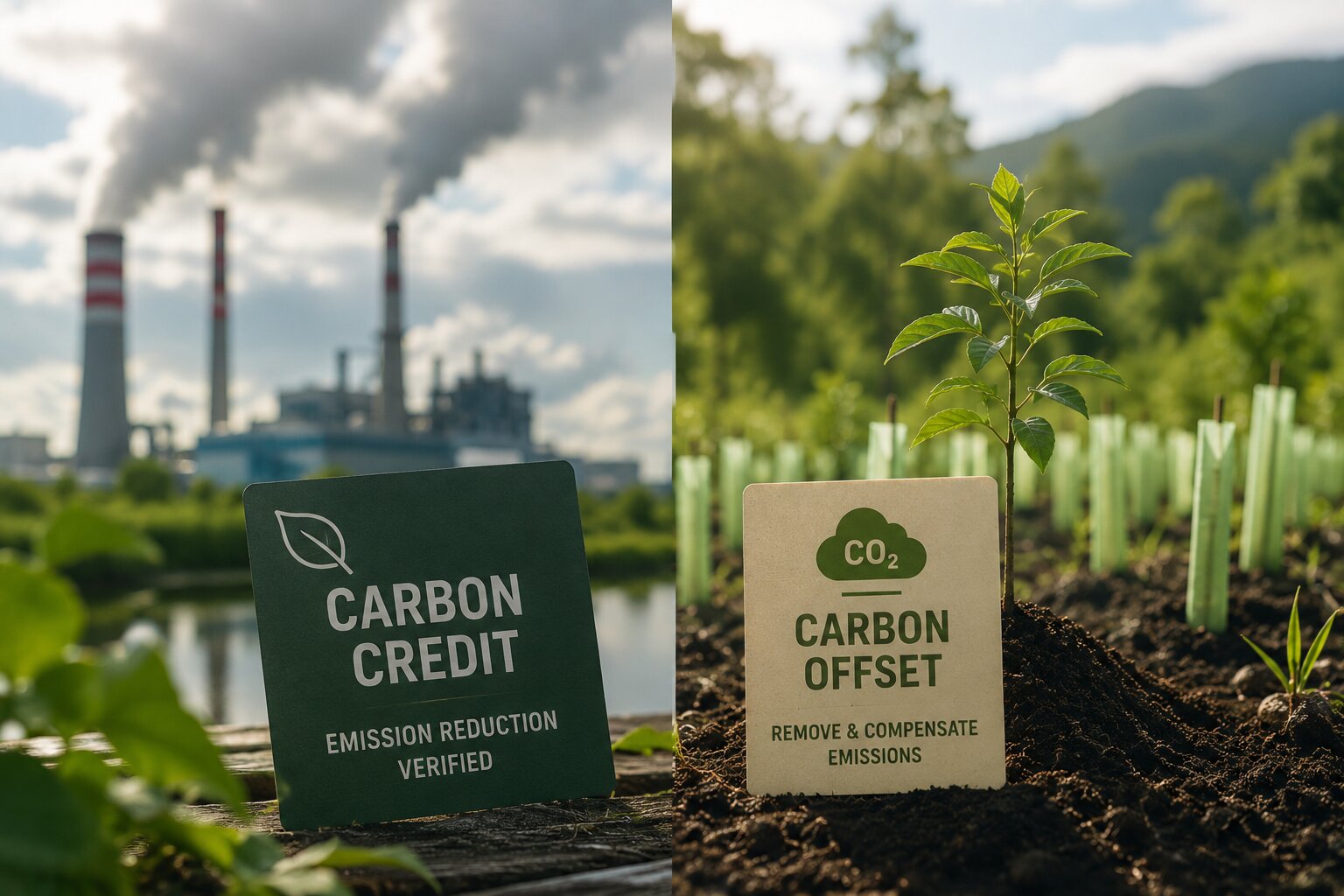

You’ve probably heard the terms carbon credits and carbon offsets thrown around in climate discussions. They’re often used interchangeably, which creates a lot of confusion. Both are measured in tonnes of CO₂ equivalent (tCO₂e), but they work in fundamentally different ways. Understanding the difference isn’t just academic it matters for businesses, investors, and anyone serious about making a real climate impact.
Carbon credits are typically allowances in mandatory compliance markets such as the EU Emissions Trading System, where regulators cap emissions and companies trade permits. Carbon offsets are voluntary credits bought to compensate for emissions by funding projects like reforestation or direct air capture. Prices diverge sharply, from a few dollars for older avoidance credits to over a thousand dollars for engineered removals. Quality varies widely, so buyers increasingly look for independently verified, high-integrity credits.
The Short Answer: What Is the Difference?

Imagine two ways to deal with a ton of carbon dioxide. In the first, a government hands out a limited number of permits and says: You may emit only what you hold permits for. In the second, you keep emitting, but you pay someone elsewhere to plant trees or capture carbon so that, on paper, your tonne is canceled out. The first is the world of carbon credits. The second is the world of carbon offsets.
Both use the same unit, one tonne of carbon dioxide equivalent, written as tCO2e. The “equivalent” matters because it converts other greenhouse gases, like methane, into a comparable CO2 figure based on their warming power. To put a tonne in perspective, driving an average car from New York to Las Vegas produces roughly one tonne of CO2e.
The confusion is understandable because the markets overlap in language. Voluntary offsets are frequently called “offset credits,” and a credit only truly becomes an offset at the moment a buyer retires it against their own emissions. Still, the core distinction is worth holding onto: a credit in a compliance market is a permit to pollute up to a cap, while an offset is a voluntary claim that an equivalent tonne was dealt with elsewhere.
Carbon Credits Explained

Carbon credits, in their strictest sense, are the currency of compliance markets, also called regulated or cap-and-trade markets.
Here is the logic. A government sets a hard cap on total emissions for covered industries, then issues a matching number of allowances. Companies that emit less than their allocation can sell their surplus. Companies that emit more must buy. Over time, the regulator lowers the cap, which tightens supply and pushes the carbon price up, creating a financial reason to cut emissions. This is the model behind the European Union Emissions Trading System (EU ETS), California’s cap-and-trade program, China’s national ETS, and South Korea’s K-ETS.
The scale is enormous. Compliance markets account for the vast majority of carbon trading by value, and the broader carbon market runs into the hundreds of billions of dollars. Crucially, a compliance allowance and a voluntary offset are not interchangeable. An EU ETS allowance cannot be retired against a voluntary net-zero claim, and vice versa. They serve different buyers and obey different rules.
The conceptual roots go back to the 1997 Kyoto Protocol, which formalized the idea of tradeable emissions units and gave rise to both compliance and voluntary markets.
Carbon Offsets Explained
Carbon offsets live in the Voluntary Carbon Market (VCM). No law forces a company to buy them. They are purchased by businesses, organizations, and individuals who want to compensate for emissions they cannot yet eliminate, often as part of a net-zero or “carbon neutral” commitment.
An offset is project-based. Instead of a top-down cap, each credit is generated by a specific activity that reduces, avoids, or removes greenhouse gases. The buyer funds the project, receives credits equal to the verified tonnes, and then retires them so the same tonne cannot be claimed twice.
The voluntary market is small relative to compliance markets, covering well under 1 percent of global emissions, but it plays an outsized role in financing climate projects in places where regulation does not reach. It also carries real co-benefits when done well, such as biodiversity protection, cleaner air, and local jobs.
The lifecycle of an offset typically runs: a project is designed under a recognized methodology, the activity is monitored and measured, an accredited third party verifies the results, a registry issues one credit per verified tonne, and finally a buyer retires the credit against their footprint. That last step, retirement, is the moment a credit becomes an offset.
Carbon Credits vs Carbon Offsets: Side by Side
| What it represents | A permit to emit one tonne of CO2e | A claim that one tonne was avoided or removed elsewhere |
| Market | Compliance, regulated by governments | Voluntary, driven by corporate and individual choice |
| Mandatory? | Yes, for covered sectors | No |
| Who issues it | Regulators (EU Commission, California Air Resources Board, etc.) | Independent standards (Verra, Gold Standard, ACR, Climate Action Reserve) |
| Core mechanism | Cap-and-trade | Project-based finance |
| Typical price | Roughly €80 to €90 per tonne (EU ETS) | Under $5 to over $1,000 per tonne |
| Main goal | Prevent emissions by capping them | Compensate for emissions already produced |
| Origin | Kyoto Protocol compliance frameworks | Corporate climate commitments and CSR |
A simple way to remember it: credits help prevent emissions through a legal cap, while offsets help compensate for emissions through voluntary funding.
The Types of Projects Behind Offsets
Not all offsets are created equal, and the project type is the single biggest driver of both price and credibility. Two questions sort the field.
Avoidance or removal? Avoidance credits prevent emissions that would otherwise happen, such as protecting a forest from being cut down, capturing methane at a landfill, or switching to cleaner fuel. Removal credits physically take CO2 out of the atmosphere and store it, through reforestation, soil carbon, biochar, or direct air capture.
Nature-based or engineered? Nature-based projects use ecosystems, like planting mangroves or restoring forests, where carbon is stored for decades, and buffer pools mitigatecover the risk of reversal. Engineered approaches, like direct air capture or bioenergy with carbon capture and storage, lock carbon away for centuries but cost far more.
The market increasingly rewards permanence and certainty. Removal credits generally trade above avoidance credits, and durable engineered removals sit at the very top of the price range. This reflects a structural shift: buyers concerned about reputation and future compliance are moving away from cheap, hard-to-verify avoidance credits toward credits whose impact is easier to prove and harder to reverse.
What Do They Cost in 2026?
There is no single “carbon price.” There are hundreds of micro-markets, each with its own range.
In compliance markets, the EU ETS is the global benchmark. Analyst projections put EU allowances in the region of 80 to 90 euros per tonne in 2026, with some forecasts climbing toward 130 euros by 2030 as the cap tightens. These prices are high precisely because the market is mandatory and supply is capped.
In the voluntary market, prices fragment dramatically by quality. Public averages can be misleading. One widely cited benchmark put the 2025 voluntary average around 6 dollars per tonne, but that figure is dragged down by legacy renewable energy and older avoidance credits that no longer pass quality screens. The credits that careful corporate buyers actually purchase tell a different story:
- Nature-based avoidance (such as some REDD+ forest credits): often under 15 dollars per tonne, and increasingly screened out of serious portfolios.
- High-integrity nature-based removal: roughly 15 to 35 dollars per tonne.
- Engineered removals like biochar, enhanced rock weathering, and direct air capture: from around 100 dollars to over 1,000 dollars per tonne.
Analysts describe this split as a “flight to quality” or a structural bifurcation, where credits that look identical on paper can differ in value by ten times or more. For budgeting, a credible corporate portfolio in 2026 often blends out to somewhere in the range of 25 to 80 euros per tonne, depending on how much durable removal it contains.
The Elephant in the Room: Do Offsets Actually Work?
This is the question that has reshaped the entire voluntary market, and honesty requires confronting it directly.
The evidence on offset quality is sobering. A 2024 meta-analysis covering close to a billion tonnes of credits, around a fifth of all credits ever issued, estimated that fewer than 16 percent represented real, additional emissions reductions. Forest conservation (REDD+) projects, among the most popular categories, have been especially criticized. One study found overestimation ratios as high as roughly 13 to 1, meaning that for every credit reflecting a genuine reduction, about twelve more were issued without solid backing. In early 2023, a major media investigation reported that a large share of rainforest credits from the largest standard were likely overstated or effectively worthless, triggering a sharp loss of market confidence and a price correction.
The underlying problems are structural and hard to solve. Most offsets rest on a counterfactual, a guess about what “would have happened” without the project. Inflated baselines, weak additionality (would the project have happened anyway?), and impermanence (forests can burn or be logged later) all undermine the claim that a tonne was truly canceled. Critics have likened offsets to “medieval indulgences,” a way to buy a clear conscience without changing behavior.
A fair counterweight: this is exactly why the market is now being cleaned up, and why quality and price are diverging so sharply. The credibility crisis did not end offsetting, but it ended the era of treating all credits as equal.
How Quality Is Being Fixed: Standards and Labels
A cluster of institutions now works to separate high-integrity credits from the rest.
Registries issue and track credits. The largest are Verra (the Verified Carbon Standard) and Gold Standard, alongside the American Carbon Registry and Climate Action Reserve, with Puro.earth focused on engineered removals. They define methodologies and require third-party verification.
The Integrity Council for the Voluntary Carbon Market (ICVCM) is the most important recent development. This independent governance body publishes ten Core Carbon Principles (CCPs), a global benchmark for what counts as a high-integrity credit. Programs that meet the bar are labeled “CCP-Eligible,” and qualifying credit categories can carry a “CCP-Approved” tag in registries. The intent is a clear, trusted quality signal. As of late 2025, only a small fraction of credits carried the label, even though programs covering most market volume had become eligible, and dozens of methodologies across nature, methane, and removals had been approved. Notably, the benchmark has teeth: in one 2024 assessment, around a third of credits tested did not meet the threshold.
Independent ratings agencies such as Sylvera, BeZero, and Calyx Global score individual projects, giving buyers a second opinion beyond the registry label.
The direction of travel is unmistakable. Buyers increasingly demand credits that are CCP-approved, independently rated, and audit-ready, rather than simply the cheapest tonne available.
Case Study: The REDD+ Reckoning
The clearest illustration of the quality problem is the story of REDD+, which stands for Reducing Emissions from Deforestation and Forest Degradation. These projects pay to protect forests that would otherwise be cleared, and they have made up a large share of the voluntary market.
The appeal is obvious. Standing forests store carbon, support biodiversity, and sustain communities, so paying to keep them standing seems like a clean win. The problem lies in the baseline. To issue credits, a project must estimate how much deforestation would have occurred without the funding. Set that hypothetical too high, and the project can claim to have “saved” far more forest, and far more carbon, than it actually did.
Investigations and academic studies found that many REDD+ projects did exactly this, issuing “phantom credits” tied to overstated deforestation risk. When a 2023 media investigation reported that a large portion of these rainforest credits were likely worthless, confidence in the whole category collapsed, prices fell, and buyers paused.
The response shows the market maturing. The ICVCM developed stricter benchmarks, registries revised their methodologies, and ratings agencies began flagging weak baselines. Some deforestation and cookstove credit types have since been approved under tighter rules. The lesson for buyers is permanent: a credit is only as good as the integrity of the assumptions behind it, and “it protects a forest” is not by itself proof of climate impact.
Data and Statistics at a Glance
| Unit of both credits and offsets | 1 tonne CO2e | Universal across standards |
| EU ETS allowance price, 2026 | ~€80 to €90 per tonne | Market analyst projections |
| Voluntary credits with real reductions | Fewer than 16% | Probst et al. meta-analysis (2024) |
| REDD+ overestimation ratio (one study) | Up to ~13 to 1 | West et al. (2023) |
| Voluntary market average price (2025, public) | ~$6 per tonne | Ecosystem Marketplace |
| High-integrity removal price range | ~$15 to $35 per tonne | 2026 market reporting |
| Engineered removal (DAC, biochar) | ~$100 to $1,000+ per tonne | 2026 market reporting |
| Voluntary market spending, 2025 | ~$1.04 billion | Sylvera |
| Share of global emissions covered by VCM | Under 1% | Market analyses |
Actionable Tips: How to Buy or Use Credits Well
For businesses:
- Cut first, offset last. A credibleCredible climate strategy reduces your own emissions before compensating for the remainder. Offsets are for residual emissions, not a substitute for decarbonizing.
- Prefer removal over avoidance where your strategy and budget allow, and build toward durable removals over time.
- Demand the CCP label and an independent rating. Treat a registry listing as the floor, not the finish line.
- Check additionality and permanence for any project: would it have happened anyway, and how long will the carbon stay stored?
- Watch your claims. From September 2026, EU rules restrict offset-based “carbon neutral” product claims, so align your marketing with what your credits can actually support.
- Diversify across project types and vintages to manage quality and price risk.
For individuals:
- Favor providers that name the specific project, standard, and vintage, and show retirement records.
- Be skeptical of very cheap “neutralize your flight” options, which often rely on low-integrity avoidance credits.
- Remember that reducing your own consumption is always more certain than offsetting it.
Common Mistakes and Misconceptions
Mistake 1: Treating the two terms as identical. They share a unit but differ in market, legality, and meaning. Precision matters when reading a company’s climate claims.
Mistake 2: Assuming all tonnes are equal. A 3-dollar avoidance credit and a 500-dollar direct air capture credit both say “one tonne,” but their real-world impact and durability differ enormously.
Mistake 3: Believing offsets cancel the need to cut emissions. Offsetting without reducing is the behavior that regulators and critics target most.
Mistake 4: Trusting a registry listing as proof of quality. Listing means a credit exists, not that it has been delivered. Look for the CCP label and independent ratings.
Mistake 5: Ignoring permanence. A forest credit can be reversed by fire or logging. Without buffer pools or durable storage, the “removal” may not last.
Mistake 6: Confusing compliance and voluntary credits. You cannot use an EU ETS allowance to back a voluntary net-zero claim, or the reverse.
Future Trends to Watch
The quality premium is now structural. Top-rated credits trade at multiples of low-quality ones, and that gap is expected to persist as buyers prioritize trust and durability over the cheapest tonne.
Compliance and voluntary markets are converging. Mechanisms under Article 6 of the Paris Agreement, the aviation scheme CORSIA, and the EU’s Carbon Removal Certification Framework are creating pathways where high-integrity voluntary credits can serve compliance needs, too. CORSIA participation is slated to become mandatory for many airlines from 2026.
Removals move center stage, slowly. Forward commitments for durable removal reached billions of dollars in 2025, far exceeding the credits actually delivered, which highlights both strong demand and the early, supply-constrained state of the technology.
Better data becomes essential. Buyers increasingly want decision-grade intelligence, from satellite monitoring to independent ratings, rather than relying on a single label or quote.
Regulation tightens the claims layer. As consumer-protection rules crack down on vague “carbon neutral” messaging, the link between the credits a company buys and the claims it makes will face far more scrutiny.
Frequently Asked Questions
Q: Are carbon credits and carbon offsets the same thing? A: Not quite. Both equal one tonne of CO2e, but a carbon credit is usually a compliance-market permit to emit, while a carbon offset is a voluntary purchase that funds a reduction or removal elsewhere. A credit becomes an offset when it is retired against emissions.
Q: Which is better, credits or offsets? A: They serve different purposes. Compliance credits are a regulatory tool to cap and cut emissions across an economy. Voluntary offsets let organizations compensate for emissions they cannot yet eliminate. For most companies, the priority is cutting their own emissions first.
Q: How much does a carbon offset cost? A: It ranges widely. Older avoidance credits can cost under 5 dollars per tonne, high-integrity nature-based removals roughly 15 to 35 dollars, and engineered removals like direct air capture from around 100 dollars to over 1,000 dollars.
Q: Why are some carbon offsets considered worthless? A: Many rest on inflated baselines or weak additionality, so they do not represent real reductions. One meta-analysis found fewer than 16 percent of studied credits reflected genuine reductions, which is why integrity standards now matter so much.
Q: What is the difference between avoidance and removal credits? A: Avoidance credits prevent emissions that would otherwise occur, such as protecting a forest. Removal credits physically take CO2 out of the atmosphere, through reforestation, biochar, or direct air capture. Removals generally command higher prices.
Q: What are the Core Carbon Principles? A: They are a set of ten benchmarks from the Integrity Council for the Voluntary Carbon Market that define a high-integrity credit. Credits meeting them can carry a CCP-Approved label, which buyers increasingly look for.
Q: What does it mean to retire a carbon credit? A: Retiring permanently removes a credit from circulation so it cannot be sold or claimed again. It is the moment a buyer formally counts that tonne against their own footprint.
Q: Can I use carbon offsets to become carbon neutral? A: You can, but credibly only after reducing your own emissions, and only with high-integrity credits. From September 2026, EU rules restrict product-level “carbon neutral” claims based mainly on offsets rather than real reductions.
Q: Who regulates carbon offsets? A: The voluntary market is overseen by independent standards and governance bodies like Verra, Gold Standard, and the ICVCM rather than a single government. Compliance credits, by contrast, are regulated directly by governments.
Q: Is the carbon market growing or collapsing? A: Despite talk of collapse, total voluntary market spending rose modestly in 2025 even as retirement volumes dipped slightly. The market is not disappearing; it is consolidating around quality.
Conclusion
Carbon credits and carbon offsets are easy to confuse and easy to misuse, but the core idea is simple. Both are denominated in tonnes of CO2 equivalent. Compliance credits are permits that cap pollution by law. Voluntary offsets are funding that compensates for pollution by choice. One prevents, the other compensates.
The harder truth is that not every tonetonne is real. Years of inflated baselines and phantom credits have taught buyers an expensive lesson, and the market’s response, through Core Carbon Principles, independent ratings, and a flight to durable removals, is reshaping prices and expectations. The cheapest credit is often the most expensive once reputational and climate risks are counted.
For any organization, the order of operations is what matters most: reduce your own emissions first, then compensate for what remains with credits whose integrity you can actually verify. Used that way, carbon markets are a genuine tool. Used as a shortcut, they are just an invoice for a clear conscience.
Call to Action
Building a climate strategy? Start by separating real reductions from offsetting, insist on CCP-approved and independently rated credits, and follow trusted sources like the ICVCM, UNEP, and the World Bank Carbon Pricing Dashboard for current data. Explore our related guides on spotting greenwashing to go further.
Key Takeaways
- Same unit, different systems. Both equal one tonne of CO2e, but credits sit mainly in regulated compliance markets and offsets in the voluntary market.
- Credit = permit, offset = compensation. A compliance credit is the right to emit a tonne. An offset is a claim that a tonne was avoided or removed somewhere else.
- Prices vary by more than 100 times. EU compliance allowances trade near 80 to 90 euros a tonne, while voluntary credits range from under 5 dollars to over 1,000 dollars.
- Avoidance and removal are not equal. Removal credits, especially durable engineered ones, command large premiums over avoidance credits.
- Quality is the central issue. Studies suggest most voluntary credits have not delivered the reductions claimed, which is why integrity standards now matter enormously.
- Retirement is what makes a credit an offset. A credit becomes an offset only when it is permanently retired against specific emissions.