

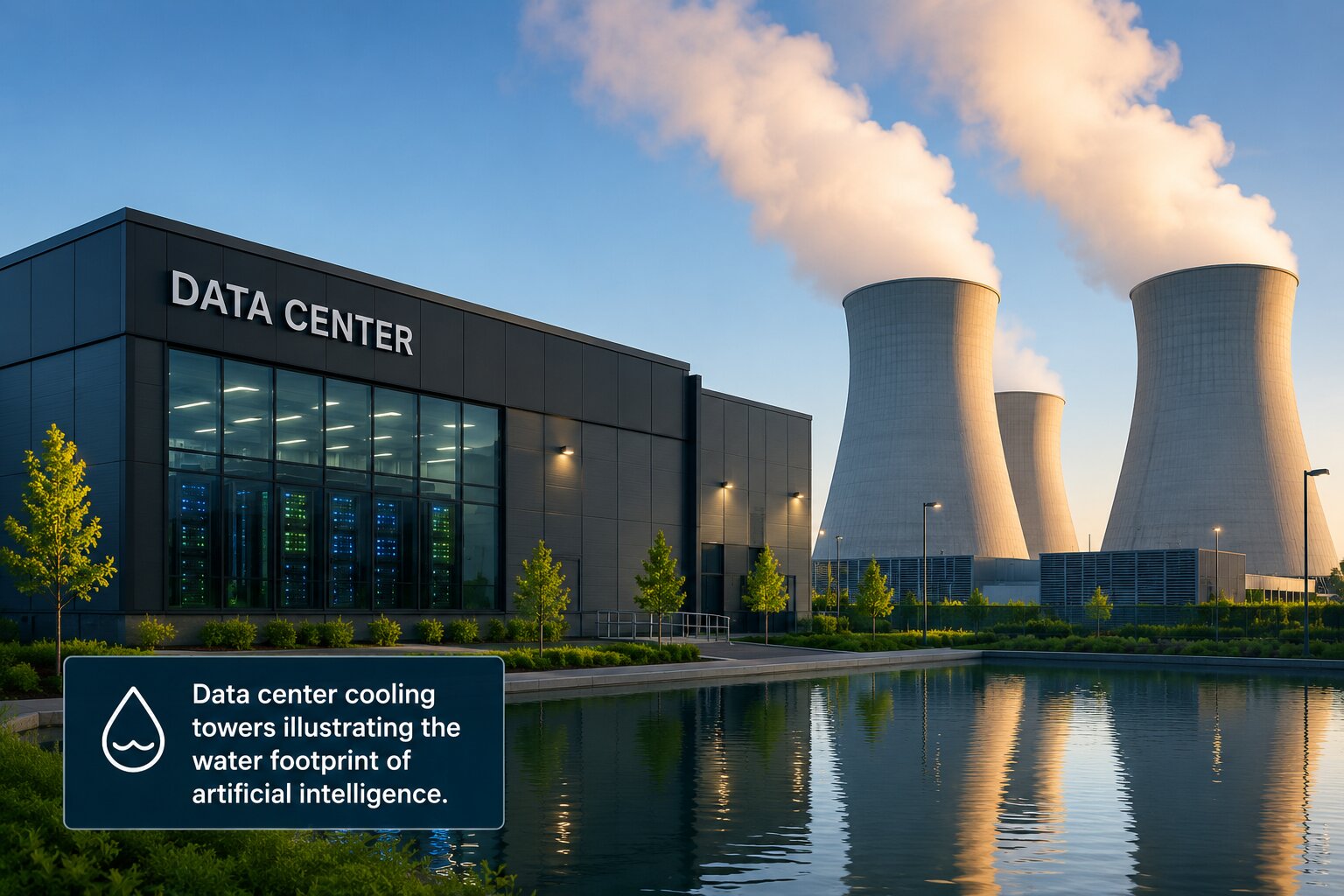

Artificial intelligence affects the environment through three connected channels: energy, water, and carbon. Training a single large model can use over a thousand megawatt-hours of electricity, but the International Energy Agency notes that day-to-day use (inference) now accounts for 80 to 90 percent of AI energy demand. Global data center electricity could roughly double from 415 TWh in 2024 to 945 TWh by 2030. Cooling these centers consumes trillions of liters of water, often in water-stressed regions. Carbon emissions are climbing too, with Google and Microsoft both reporting double-digit increases since 2020. Efficiency gains, cleaner power, and smarter cooling can soften, though not erase, this footprint.
1. Why AI’s Environmental Impact Suddenly Matters
A few years ago, the environmental cost of running software was a niche concern for engineers tuning server racks. Then generative AI arrived, and the question moved from data center basements to front pages.
The shift is physical, not just rhetorical. The International Energy Agency reports that an individual server rack in an advanced AI data center, roughly the size of a large refrigerator, could draw as much peak power by 2027 as 65 households combined. Multiply that across the warehouse-scale buildings now rising across the United States, China, and Europe, and a clear picture emerges: AI is becoming a serious actor in the global energy system.
There is a reason this matters beyond electricity bills. Energy, water, and carbon are interlinked. The power that runs a data center often comes from fossil fuels, which produce emissions. The heat that power creates must be removed, which usually means water. Pull on one thread, and the others move. Understanding AI’s environmental impact means looking at all three together, and being honest about where the evidence is solid and where it is still evolving.
2. How AI Uses Energy: Training vs Inference
AI consumes energy in two distinct phases, and people often focus on the wrong one.
Training
Training is the upfront process of building a model. It requires thousands of specialized chips running continuously for weeks or months. The numbers are striking. Researchers estimate that training the older GPT-3 model used roughly 1,287 megawatt-hours of electricity and produced around 552 tons of carbon dioxide. Frontier models trained since then are far larger.
Inference
Inference is what happens every time you actually use a model: ask a question, generate an image, summarize a document. Each individual request is small, but they happen billions of times a day.
This is the part most coverage gets wrong. According to the IEA and a recent assessment by the United Nations University, inference now accounts for an estimated 80 to 90 percent of AI’s total energy use. Once a model is deployed, the steady drumbeat of everyday queries dwarfs the one-time training cost. ChatGPT alone is estimated to process around 2.5 billion prompts per day.
The energy per task also varies enormously. A typical chat query can use roughly 200 times the energy of a simple text classification, and generating an AI image can use around 1,450 times as much. The phrase “an AI query” hides a huge range.
3. The Numbers Behind AI Energy Demand

Data centers are the physical home of AI, so their electricity use is the clearest proxy for AI’s energy footprint.
In 2024, global data centers consumed roughly 415 terawatt-hours of electricity, about 1.5 percent of the world’s total, according to the IEA’s Energy and AI analysis. That demand has been growing at about 12 percent per year over the past five years, more than four times faster than overall electricity use.
The trajectory steepens from here. The IEA’s base case projects global data center electricity consumption roughly doubling to around 945 TWh by 2030, reaching just under 3 percent of global supply, and climbing toward 1,200 TWh by 2035. To put 2025 in perspective, data center electricity use that year was comparable to the entire annual electricity consumption of France.
AI is the engine of that growth. Electricity use from AI-focused data centers surged by about 50 percent in 2025 alone, far outpacing the roughly 3 percent growth in overall global electricity demand.
The picture is highly regional. The United States and China together account for nearly 80 percent of the projected global growth to 2030. In the US, the Department of Energy’s Lawrence Berkeley National Laboratory found that data centers used about 176 TWh in 2023 (4.4 percent of national electricity) and could consume between 325 and 580 TWh by 2028, or 6.7 to 12 percent of the grid. Some local grids feel it acutely: in Ireland, data centers already use more than a fifth of national electricity.
A useful caveat: these are projections, and the IEA itself stresses real uncertainty. Bottlenecks in chips, grid connections, transformers, and turbines could slow the buildout, while breakthroughs in efficiency could blunt demand. The exact 2030 figure matters less than the direction, which is steeply upward.
4. AI’s Water Footprint: The Cost of Staying Cool
Energy gets the headlines, but water may be the more locally painful cost.
Data centers use water in two ways. Direct use is cooling: water absorbs heat from servers, often by evaporating in cooling towers. Indirect use happens at the power plants that generate the electricity, many of which are themselves water-hungry. Cooling alone can represent 30 to 40 percent of a facility’s energy use, which is why water and energy footprints are so tightly coupled.
The scale is becoming country-sized. United Nations University projects a water footprint of around 9.3 trillion liters associated with global data centers, alongside a land footprint exceeding 14,500 square kilometers. The IEA notes that an average 100-megawatt data center, which uses more power than 75,000 homes, can consume roughly 2 million liters of water per day.
Training has a thirst, too. A widely cited University of California, Riverside study (Li et al., 2023) estimated that training GPT-3 in Microsoft’s US data centers consumed about 700,000 liters of water on-site for cooling, and 5.4 million liters when indirect use is included. The same researchers projected that global AI water withdrawals could reach 4.2 to 6.6 billion cubic meters per year by 2027, several times the annual water consumption of a country like Denmark.
The fairness problem is geographic. Nearly half of the world’s 9,000-plus data centers sit in regions of high water stress. When a facility draws millions of liters a day in a drought-prone area, that water is effectively redirected from agriculture, ecosystems, and households. Google reported that its data center water consumption rose nearly 88 percent between 2019 and 2024, a trend echoed across the industry.
5. AI’s Carbon Footprint and the Emissions Problem
Carbon is where corporate climate pledges are colliding with AI ambition.
Two of the most transparent companies illustrate the strain. Microsoft reported that its total emissions rose about 23 percent above its 2020 baseline by fiscal year 2024, driven largely by data center construction for AI workloads, with indirect (Scope 3) emissions making up more than 97 percent of its footprint. Google reported that its greenhouse gas emissions climbed roughly 48 percent since 2019, attributing the rise to data center energy use and supply chain emissions. Google also acknowledged it was no longer maintaining operational carbon neutrality.
The IEA estimates that emissions from data center electricity use stand at about 180 million tonnes of CO2 today and could rise to 300 million tonnes by 2035 in its base case.
There is an important accounting nuance worth flagging for trust. Companies often report market-based emissions, which credit their purchases of renewable energy, rather than location-based emissions, which reflect the actual mix of clean and dirty power on the local grid at the time of use. The two can differ substantially. When Google reports a reduction in “data center energy emissions,” critics point out that its actual location-based electricity use rose sharply in the same period. Neither number is wrong, but they answer different questions, and readers should know which one they are seeing.
A balanced view also notes the other side. Carbon intensity per unit of compute is generally falling as chips and software improve. The problem is that absolute emissions are still rising because growth is outpacing efficiency.
6. Beyond Carbon: Land, Minerals and E-Waste
The footprint does not end at the meter and the tap.
AI hardware has a short, demanding life. Specialized chips and servers are replaced quickly as performance improves, creating a growing stream of electronic waste that contains hazardous materials and requires careful disposal. Manufacturing those chips also depends on mined minerals and significant water and energy upstream, costs that rarely appear in per-query estimates.
Land is a quieter pressure. The UN University assessment puts the land footprint of global data centers above 14,500 square kilometers and rising. Each facility also brings local effects: traffic, noise, heat, and competition for grid capacity that can raise electricity costs for nearby residents. Research from UC Riverside and Caltech has even attributed billions of dollars in US health costs to air pollution linked to data center power generation, a reminder that “environmental impact” and “public health” overlap.
7. Case Study: What One Query Really Costs
In August 2025, Google did something unusual: it published a detailed technical breakdown of the resources behind a single Gemini text prompt. It remains the most transparent disclosure from a major AI provider, and it is a useful anchor for the whole debate.
Google’s headline figures for the median Gemini text prompt were:
- 0.24 watt-hours of electricity (about the energy of running a microwave for one second)
- 0.03 grams of CO2 equivalent
- 0.26 milliliters of water (roughly five drops)
Two details make this case study instructive.
First, the company reported that the energy per median prompt fell 33-fold over a single year, thanks to more efficient models and custom hardware. Efficiency is real and rapid.
Second, the breakdown shows why narrow estimates mislead. Google’s AI chips accounted for only 58 percent of that 0.24 watt-hours. Supporting processors and memory added 25 percent, idle backup machines another 10 percent, and data center overhead, like cooling, the final 8 percent. A chip-only estimate would have reported just 0.10 watt-hours, less than half the true figure.
The lesson cuts both ways. Per query, the cost is genuinely small, comparable to watching a few seconds of television. But independent experts, including the UC Riverside team behind the original water research, criticized the disclosure for excluding indirect water use and for relying on market-based carbon accounting. And Google has not revealed how many total queries it handles per day, so the global total remains unknown. A small number times an enormous, undisclosed volume is still an open question.
8. Data and Statistics at a Glance
| Global data center electricity, 2024 | ~415 TWh (1.5% of world supply) | IEA |
| Projected data center electricity, 2030 | ~945 TWh (~3% of supply) | IEA base case |
| AI-focused data center electricity growth, 2025 | ~50% | IEA |
| US data center electricity, 2023 | 176 TWh (4.4% of US grid) | DOE / LBNL |
| US projection, 2028 | 325 to 580 TWh (6.7 to 12%) | DOE / LBNL |
| Inference share of AI energy use | 80 to 90% | IEA / UN University |
| Training GPT-3 (energy) | ~1,287 MWh | Research estimate |
| Median Gemini prompt | 0.24 Wh, 0.03 g CO2e, 0.26 mL water | Google (2025) |
| Global AI water footprint (projected) | ~9.3 trillion liters | UN University |
| 100 MW data center water use | ~2 million liters/day | IEA |
| Data centers in high water stress areas | ~50% of 9,000+ globally | World Resources Institute / Bloomberg |
| Microsoft emissions vs 2020 | +23% (FY2024) | Microsoft sustainability report |
| Google emissions since 2019 | ~+48% | Google environmental report |
9. Actionable Tips to Reduce AI’s Footprint
You do not need to abandon AI to lower its impact. The biggest levers sit with infrastructure operators, but individuals and organizations have real choices too.
For everyday users and businesses:
- Match the model to the task. Use smaller, faster models for simple jobs. A lightweight model can handle grammar checks or classification at a fraction of the energy of a frontier reasoning model.
- Avoid needless regeneration. Each re-roll, retry, and redundant call has a cost. Write clearer prompts to get useful answers the first time.
- Batch and consolidate. Combine related requests rather than firing dozens of small ones.
- Consider local models for routine work. Running a small model on your own device can eliminate per-query cloud water use entirely for suitable tasks.
- Favor providers with credible disclosures. Choosing vendors that publish transparent energy, water, and carbon data rewards accountability.
For infrastructure operators:
- Adopt liquid or direct-to-chip cooling, which can cut direct water use by 70 to 90 percent.
- Locate facilities in cooler, water-abundant regions and schedule heavy workloads for cooler hours.
- Procure genuinely additional clean energy and invest in water replenishment in the watersheds where they operate.
- Extend hardware lifetimes and design for reuse to slow e-waste.
10. Common Mistakes and Misconceptions
Mistake 1: Blaming training. Training a model is energy-intensive, but inference is where most ongoing energy goes. Focusing only on training misses the higher, recurring cost.
Mistake 2: Treating “a query” as one fixed number. A simple text reply, a long reasoning chain, and an AI image differ by orders of magnitude. Averages hide this.
Mistake 3: Shaming individual users. Individual chatbot use is a small slice of total data center load, well behind video streaming, social media, and cloud storage. The high-leverage decisions are infrastructure choices: cooling, energy sourcing, and model efficiency.
Mistake 4: Confusing market-based and location-based carbon figures. A company can report falling emissions through clean-energy purchases while its actual grid electricity use rises. Always check which figure is being quoted.
Mistake 5: Ignoring water. Carbon dominates headlines, but in dry regions, water is often the binding local constraint and the source of community conflict.
11. Future Trends to Watch
The next few years will decide whether AI’s footprint stabilizes or keeps climbing.
Efficiency keeps improving. Techniques like mixture-of-experts models, quantization, and custom chips are driving dramatic per-task gains, as Google’s 33-fold reduction shows. New low-power inference chips entering the market in 2026 will push further in this direction.
The rebound effect looms. History suggests that as computing gets cheaper and more efficient, people simply use more of it. Efficiency alone may not reduce total demand if usage explodes to fill the gap.
Power sourcing is shifting. The IEA projects that renewables will meet about half of new data center demand to 2035, supported by natural gas and a revival of nuclear, including the first small modular reactors expected around 2030.
Grids are the real bottleneck. Building transmission lines can take four to eight years, and the wait for transformers has doubled in three years. The IEA estimates that around 20 percent of planned data center projects risk delay from grid constraints.
Transparency and regulation are tightening. Google’s disclosure set a precedent. Expect more standardized reporting and policy attention, especially around water permits and grid impacts.
12. Frequently Asked Questions
Q: How much electricity does AI use? A: AI itself is hard to isolate, but its home, data centers, used about 415 TWh globally in 2024 (1.5% of world supply) and could reach roughly 945 TWh by 2030, per the IEA. AI-focused facilities are the fastest-growing segment.
Q: How much water does one ChatGPT or AI query use? A: Estimates vary widely with method and location. Google measured its median Gemini text prompt at 0.26 milliliters of direct water. Other estimates that include indirect use put a longer query closer to half a liter. The honest answer is that it depends heavily on the model, the task, and the data center.
Q: Is training or using AI worse for the environment? A: At a global level, using AI (inference) accounts for an estimated 80 to 90 percent of its energy demand, because everyday queries happen billions of times. Training is intense but one-time.
Q: Does AI increase carbon emissions? A: Yes, in absolute terms. Major operators like Microsoft and Google have reported rising emissions tied to AI data center growth, even as efficiency per unit of compute improves.
Q: Why is AI water use a concern if a query is just a few drops? A: Because of scale and place. Billions of queries add up, and many data centers sit in already water-stressed regions where withdrawals compete with farms and households.
Q: Are tech companies doing anything about it? A: Many are investing in liquid cooling, renewable and nuclear power, water replenishment, and efficiency research. Results are mixed, and clean-energy supply is struggling to keep pace with growth.
Q: Will AI ever be carbon neutral? A: It is possible in principle if powered by genuinely clean electricity and matched by water replenishment, but current growth is outrunning clean supply. Several companies have walked back or restructured their neutrality claims.
Q: Does using a smaller AI model actually help? A: Yes. Smaller models use far less energy and water per task. Matching the model to the job is one of the simplest ways to cut impact.
Q: How does AI compare to other digital activities? A: Within data centers, video streaming, social media, and cloud storage each account for larger shares of load than chatbot use today, though AI is the fastest-growing driver.
Q: Is the data on AI’s footprint reliable? A: It is improving but still uncertain. Few companies disclose fully, and estimates depend on assumptions about hardware, utilization, and energy mix. Treat precise totals with appropriate caution.
13. Conclusion
AI’s environmental impact is neither the apocalypse some headlines suggest nor the rounding error its boosters imply. The truth sits in between, and it is moving fast.
Per query, the cost is small, a few drops of water and a sliver of a watt-hour. But AI runs at planetary scale, and the infrastructure behind it is reshaping electricity grids, straining water supplies in dry regions, and pushing corporate emissions upward even as per-task efficiency improves. The most useful framing is not “is AI good or bad for the planet” but “how do we build and use it so the benefits arrive without the footprint running away from us.”
That depends on decisions being made right now: how data centers are cooled, where they are built, what powers them, and how honestly their impacts are measured. Efficiency, clean energy, and transparency can bend the curve. Scale and the rebound effect can straighten it again. The outcome is not yet written.
Call to Action
Want to use AI more responsibly? Start by choosing efficient models for routine tasks, supporting providers that publish transparent sustainability data, and following credible sources like the IEA, UNEP, and the IPCC for the latest evidence.
Key Takeaways
- Energy is the headline issue. Global data center electricity use was about 415 TWh in 2024 and could reach roughly 945 TWh by 2030, per the IEA. AI-focused facilities alone grew their electricity use by around 50% in 2025.
- Inference outweighs training. Running models for billions of daily queries now drives most AI energy use, not the one-time training process.
- A single query is tiny, but scale matters. Google measured its median Gemini text prompt at 0.24 watt-hours, 0.03 grams of CO2e, and 0.26 milliliters of water. Multiply that by billions of prompts, and the totals become significant.
- Water is the hidden cost. Cooling and power generation tie AI to large freshwater withdrawals, often concentrated in dry regions.
- Carbon goals are slipping. Major tech firms have reported rising emissions as AI buildouts outpace clean-energy supply.
- Solutions exist. Efficient chips, liquid cooling, renewable and nuclear power, and transparent reporting can all reduce the footprint.