

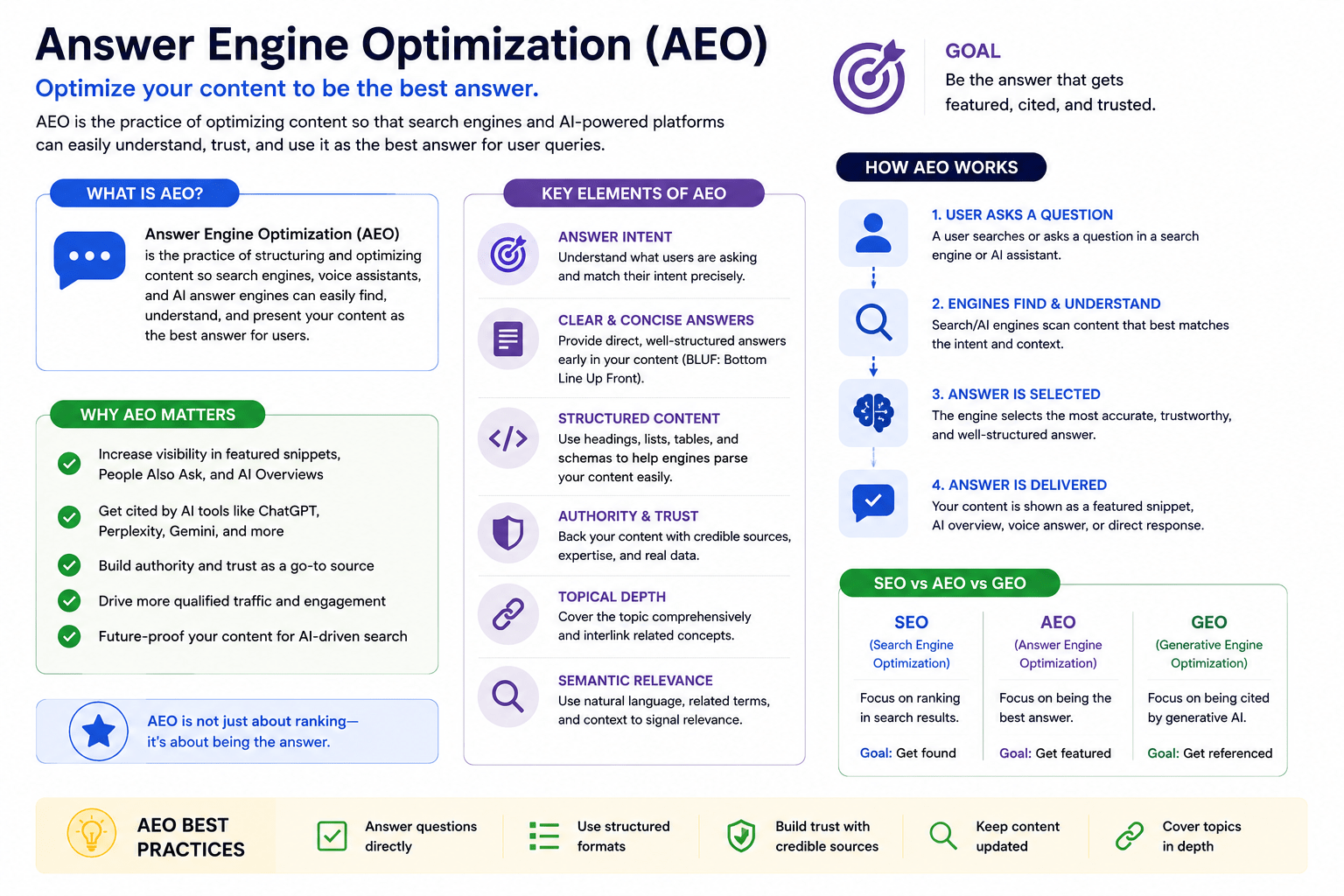

Most people who stumble across the term “answer engine optimization” assume it’s just another name for something they already know. Featured snippets, maybe. Or voice search. Or that thing where Google shows a boxed answer above the regular results.
They’re not wrong, exactly. But they’re not seeing the full picture either.
AEO is broader than any one of those things, and in 2026 it’s more consequential than it’s ever been because the systems that answer questions directly have multiplied beyond Google’s featured snippets into a whole ecosystem of AI-powered platforms that now handle a significant share of the world’s information queries.
Search has fundamentally changed. Instead of presenting users with a list of ten blue links, modern search engines and AI assistants increasingly provide direct answers. Platforms like Google AI Overviews, ChatGPT, Perplexity, Gemini, Claude, Microsoft Copilot, and Grok are reshaping how people discover information, compare products, and make decisions.
As someone who has spent years building Buddymantra, publishing hundreds of educational articles, and studying how AI systems retrieve, summarize, and cite information, I’ve seen this shift happen firsthand. Traditional SEO remains essential, but creating content that AI systems can confidently extract and reference has become equally important. That practical experience—combined with ongoing testing across multiple AI search platforms forms the foundation of this guide.
This guide explains what AEO actually is, how it relates to SEO and GEO, and most practically what you need to do differently if you want your content to become the answer rather than one of ten results competing for the click.
What Answer Engine Optimization Actually Means

Let’s start with a definition that’s specific enough to be useful. Answer engine optimization is the practice of structuring and writing content so that search engines and AI platforms present it directly as the answer to a user’s question rather than as one of many results the user has to evaluate and choose from.
The “answer engine” in AEO refers to any system that returns a direct answer rather than a list of links. That includes Google’s featured snippets and Knowledge Panels, Google’s AI Overviews, voice search results from Google Assistant, Siri, and Alexa, and conversational AI platforms like ChatGPT, Perplexity, and Gemini.
What all of these systems have in common is that they make a curatorial decision. Instead of presenting ten options and letting the user choose, they select one source or synthesize across a few and present that as the answer. The user’s trust is directed at the answer engine itself, and the answer engine’s credibility depends on selecting good sources.
That curatorial dynamic is why AEO matters. When you optimize for it successfully, your content isn’t one of ten options. It’s the answer. That’s a fundamentally different kind of visibility, with different conversion implications and different brand positioning effects.
According to research by Search Engine Land, featured snippets and AI-generated answers combined now appear on the majority of informational queries. For the question-based searches that drive enormous volumes of traffic in categories like health, finance, technology, education, and how-to content, answer placement is increasingly the only placement that matters for generating meaningful clicks.
Why AEO Has Become More Important in 2026
AEO isn’t new. SEO practitioners have been optimizing for featured snippets since Google introduced them in 2014. But the stakes have changed substantially in the last two years, for reasons that compound on each other.
The first is scale. Google’s AI Overviews now reach over two billion users monthly, according to Search Engine Land’s reporting. That’s not a supplementary feature it’s the primary search experience for an enormous portion of the world’s population. When AI Overviews appear, they appear above organic results, above ads, above everything. They’re the first thing a user sees.
The second is behavior change. Bain & Company’s research found that 60% of searches now end without a click to an external website. The percentage is even higher around 93% for queries that trigger AI Mode responses, according to AEO Engine’s 2026 state of AI search report. Users are reading the answer and moving on. If your content isn’t the answer, it may as well not exist for that query.
The third is platform proliferation. In 2020, optimizing for Google’s featured snippets was essentially all you needed to think about for answer placement. In 2026, you need to consider Google AI Overviews, Google AI Mode, ChatGPT, Perplexity, Gemini, Claude, Microsoft Copilot, and Grok each with different systems, different content preferences, and different citation behaviors.
Semrush’s AI search trends data for 2026 shows that commercial keywords triggering AI Overviews increased by 128% year-over-year. The idea that AI answers are only relevant for informational queries has been definitively disproven. Purchase decisions, product comparisons, service evaluations all of these are increasingly being mediated by answer engines.
The opportunity side of this is real, too. The GEO-BENCH research from Princeton found that content optimized for AI extraction can achieve 30–40% greater visibility in AI-generated answers compared to unoptimized content on the same topic. The gap between AEO-optimized and unoptimized content is measurable and significant.
AEO vs SEO vs GEO The Clearest Comparison

These three terms appear together constantly, and the distinctions between them matter for knowing where to direct your effort.
SEO Search Engine Optimization is the foundation. It’s the practice of improving a website’s visibility in traditional search engine results pages. When you think about keyword research, backlink building, page speed optimization, and meta descriptions, you’re thinking about SEO. The target is a ranked position in a list of results. Success is measured in rankings, organic clicks, and traffic.
AEO Answer Engine Optimization is a layer on top of SEO that focuses specifically on winning direct answer placements. Featured snippets, Knowledge Panels, People Also Ask boxes, voice search results, and AI-generated answers are all AEO territory. The target isn’t a position in a list it’s the answer that appears before the list, or instead of it. AEO can be thought of as SEO with a specific focus on question-based queries and direct-answer formats.
GEO Generative Engine Optimization is the most recent evolution, focused specifically on AI-generated answers from platforms like ChatGPT, Perplexity, and Google AI Mode. GEO shares significant overlap with AEO but extends it to cover the distinct requirements of AI citation systems RAG-based retrieval, multi-platform presence, AI-specific structural signals, and freshness requirements that differ from traditional search.
The practical way to think about the relationship: AEO is the parent category. GEO is a specific, evolved form of AEO focused on AI-generative platforms. SEO is the foundation that supports both.
| Primary target | Ranked list position | Direct answer placement | AI-generated answer citation |
| Key platforms | Google, Bing | Google (snippets, PAA, AI Overviews), voice assistants | ChatGPT, Perplexity, Google AI Mode, Gemini, Claude |
| Core content signal | Relevance + authority | Directness + structure | Extractability + statistics + freshness |
| Success metric | Rankings + traffic | Snippet wins + zero-click impressions | Citation frequency + AI share of voice |
| Relationship to others | Foundation for AEO + GEO | Extends SEO | Extends AEO |
How Answer Engines Decide What to Show
Understanding this changes how you write. Not just what you write about, but the specific structural decisions you make in every piece of content.
Different answer engines use different systems, but some common patterns emerge across all of them.
Google’s Featured Snippets
Google’s featured snippet algorithm selects content that answers a specific question directly, concisely, and accurately. According to Ahrefs’ featured snippet research, the page that ranks first organically wins the featured snippet only about half the time meaning a well-structured page at position two or three can outcompete the top-ranked page if its content format is more snippet-friendly.
The factors that influence snippet selection include: the presence of a direct, concise answer close to the top of the content; formatting that matches the query type (paragraph for definitional questions, list for how-to queries, table for comparison queries); and the use of the exact question being asked as a heading within the content.
Google’s People Also Ask
PAA boxes are a related system that surfaces additional questions related to the original query, each with a collapsed answer. Semrush’s PAA research found that PAA boxes appear on more than 40% of all queries and are expanding in prevalence. Each PAA question represents an opportunity to place an additional answer, and clicking on a PAA answer often triggers the display of further related questions, creating a discovery loop that extends your content’s reach.
AI Overviews and AI Mode
Google’s AI Overviews use Retrieval-Augmented Generation the same technology underlying most modern AI search platforms. When a query triggers an AI Overview, Google’s system retrieves relevant content from its index, evaluates it for quality and relevance, and synthesizes a response. The response may or may not include visible citations linking back to source pages.
Google’s official guidance on AI Overviews confirms that the same core quality systems used for traditional ranking apply to AI Overview selection. EEAT signals, technical quality, and content relevance all matter. The additional AEO layer is structural: direct answers, clear organization, and schema markup that helps the AI identify what type of content each section contains.
Voice Search
Voice search results are a single spoken answer no list, no options, just one response delivered audibly. The content selected for voice search results is almost always drawn from a featured snippet or a highly authoritative source for that query type. The formatting requirements are specific: the answer needs to work as a standalone spoken response, which means it needs to be self-contained, concise (ideally under 30 words for the core answer), and written in natural spoken language rather than visual formatting.
Google’s own research on voice search indicates that voice answers tend to come from pages that load quickly, are mobile-friendly, and use HTTPS baseline technical requirements that overlap entirely with good SEO hygiene.
Conversational AI Platforms
ChatGPT, Perplexity, Gemini, and Claude operate on variations of the RAG framework described in more detail in the GEO sections of this series. The short version: they retrieve content from their indexes or from live web crawls, evaluate it for relevance and authority, and use it to generate a synthesized response. Content that is structured for easy extraction direct answers at the top, explicit facts with sources, FAQ schema, clear headings performs better in these systems than content written as continuous narrative prose.
The Content Formats That Consistently Win in Answer Engines
Not every article has the same chance of becoming an AI citation or earning a featured snippet.
After reviewing hundreds of search results and tracking how AI platforms reference content on Buddymantra, one pattern stands out. Answer engines consistently favor content that is easy to understand, logically organized, and focused on solving a specific user intent.
Instead of trying to optimize every article the same way, focus on the content formats that naturally align with how answer engines retrieve information.
Definition and Explanation Content
“What is X?” queries are among the highest-volume question-based searches in most niches. Content that answers these questions directly with a clear, concise definition in the first paragraph, followed by a deeper explanation is strongly positioned for featured snippet placement.
Definition-based searches remain one of the most common query types across Google and AI platforms.
Questions such as:
- What is Answer Engine Optimization?
- What is Retrieval-Augmented Generation?
- What is EEAT?
all require concise explanations before readers need additional detail.
The best-performing definition articles usually begin with a direct answer between 40 and 60 words, followed by a more detailed explanation, practical examples, and supporting context.
For example:
Less Effective
Search has changed significantly over the past few years. There are many ways businesses can optimize their websites for AI search.
Better
Answer Engine Optimization (AEO) is the process of structuring content so search engines and AI platforms can present it as a direct answer instead of another search result.
The second example immediately answers the user’s question, making it easier for both readers and AI systems to extract.
How-To Guides
How-to articles continue to perform exceptionally well because they naturally follow a structured format.
Instead of writing long paragraphs, break each process into clearly numbered steps.
For example:
- Identify the user’s primary question.
- Answer it immediately.
- Expand with supporting evidence.
- Add examples.
- Include FAQs.
Each step should represent a single action.
Avoid combining multiple instructions into one paragraph.
Comparison Content
Comparison content is becoming increasingly valuable as more purchase decisions begin inside AI assistants.
Queries like:
- AEO vs SEO
- Carbon Credits vs Carbon Offsets
- ChatGPT vs Gemini
all require structured comparisons.
Instead of explaining differences across several paragraphs, summarize them in a table.
| Feature | AEO | SEO | GEO |
|---|---|---|---|
| Primary goal | Become the answer | Rank in search | Earn AI citations |
| Main platforms | Featured Snippets, AI Overviews | Google & Bing | ChatGPT, Perplexity, Gemini |
| Success metric | Answer visibility | Rankings | Citation frequency |
Tables reduce cognitive load for readers while making information easier for AI systems to retrieve. A comparison table with clear headers and specific data points is easy for both Google’s snippet algorithm and AI retrieval systems to extract and present. A comparison written as flowing prose, however thorough, is harder to extract cleanly.
FAQ Content
Frequently Asked Questions remain one of the most reliable ways to improve answer visibility. Each question represents another opportunity to satisfy search intent. Well-written FAQs also support:
- Google Featured Snippets
- People Also Ask
- Voice Search
- AI citations
Every FAQ answer should be self-contained. A reader should understand the answer without reading the rest of the article. That same principle makes the content easier for AI models to quote accurately.
Research from Frase.io found that content with the FAQPage schema receives approximately three times more AI citations than equivalent content without it. For traditional featured snippets, PAA appearances are a direct function of having well-structured FAQ content on relevant questions.
Statistics and Original Research
One noticeable trend across AI-generated responses is the preference for evidence-backed statements.
Whenever possible, support important claims with:
- Published research
- Industry reports
- Government data
- Academic studies
- First-party research
Original data creates information gain.
Instead of repeating existing information, you contribute something new to the web.
That significantly increases the likelihood of citations.
Original Examples
Many articles explain concepts.
Far fewer demonstrate them.
One strategy that has worked consistently on Buddymantra is including simple before-and-after examples.
For example, instead of saying:
Write concise introductions.
Show readers exactly what that looks like.
Examples improve comprehension for readers while giving AI systems structured information that is easier to retrieve.
Definition Glossaries
In technical and specialized niches, glossary-style content one term, one definition, brief elaboration is highly effective for AEO. Each entry is a standalone answer to a definitional query, structured exactly as answer engines prefer. A comprehensive glossary in a focused niche can earn hundreds of featured snippet placements for individual term definitions.
In my testing across Buddymantra articles, AI platforms consistently favored pages that demonstrated first-hand expertise rather than simply repeating information already available elsewhere. Original examples, unique insights, and practical observations appeared to strengthen citation frequency because they provided genuine information gain instead of recycled summaries.
That observation reinforces an important principle.
AI systems are becoming increasingly effective at identifying content that contributes something new.
The future of search will reward originality as much as optimization.
Seven Practical AEO Techniques You Can Implement Today
1. Answer the question in the first paragraph
This is the single most impactful structural change that most content can make. Your introduction should contain a direct, concise answer to the primary question the article addresses. Two or three sentences. Specific, not vague. Written as a complete thought that works without any surrounding context.
This serves both traditional featured snippet selection and AI citation systems. It also serves readers people who search for answers want the answer, not a three-paragraph warm-up before the answer appears.
2. Use questions as H2 and H3 headings
Heading text that mirrors common search queries signals to answer engines that this section addresses that specific question. “What is AEO?” as a heading, followed by a direct answer, is more likely to win snippet placement than “Understanding the Basics” followed by the same answer.
Ahrefs’ content research consistently shows that question-format headings are strongly associated with featured snippet wins. Review your target keywords, identify which have question variants, and structure your headings to match.
3. Keep direct answers between 40 and 60 words
This is the sweet spot for featured snippet selection based on extensive analysis of which content formats win. Long enough to be complete and accurate. Short enough to be extracted and presented as a direct answer without truncation.
The 40–60 word range applies to the core definition or answer paragraph. The full article can and should be much longer depth and comprehensiveness matter for both authority and topical coverage. But the answer itself should be tight.
4. Structure list content properly
For how-to content and listicles, use proper HTML ordered lists (<ol>) and unordered lists (<ul>) rather than manually numbered paragraphs. Google’s snippet algorithm and AI retrieval systems both parse HTML structure. A properly marked-up numbered list is more extractable than “Step 1: … Step 2: …” written as separate paragraphs.
Each list item should be self-contained a complete action or point that makes sense without reading the surrounding items. Items that depend on each other for meaning don’t extract cleanly.
5. Implement the FAQ schema on every FAQ section
If your content includes a FAQ section and for AEO purposes, most content should implement FAQPage schema markup. This is JSON-LD code in your page’s <head> that explicitly tells Google and AI crawlers that this section contains structured question-and-answer content.
Google’s structured data documentation provides the exact implementation specification. Most modern CMS platforms have plugins that generate this automatically from designated FAQ sections. The lift is material: three times more AI citations and direct eligibility for Google’s FAQ rich results.
6. Add tables for comparison and statistical content
Tables are one of the most consistently effective formats for featured snippet wins on comparison and data queries. Google’s snippet algorithm extracts table content readily and presents it as a visually rich result. AI systems parse table structure effectively and cite tabular data in generated answers.
The key is keeping tables simple enough to render correctly in a snippet context. Too many columns, merged cells, or complex formatting reduces extractability. A clean table with four to six columns and clear headers performs better than a complex one.
7. Target “People Also Ask” questions deliberately
Review the PAA box that appears for your primary keyword. Every question in that box is an answer engine explicitly telling you what related questions people are asking. Building a section or subsection that addresses each PAA question with the question as the heading and a direct answer following is one of the most reliable ways to expand your answer engine presence beyond the primary featured snippet.
According to Semrush’s PAA analysis, each PAA answer you win can trigger additional related questions, creating an expanding visibility loop. A single well-structured article that addresses five to seven PAA questions can earn multiple answer placements simultaneously.
Before and After: An AEO Example
Traditional Introduction
Search engine optimization has evolved significantly over the years, and businesses need to adapt to new technologies if they want to remain competitive.
This paragraph doesn’t answer anything.
It creates unnecessary friction.
AEO-Optimized Introduction
Answer Engine Optimization (AEO) is the practice of structuring content so search engines and AI platforms can present it as a direct answer to a user's question instead of another search result.
The second version immediately satisfies search intent.
Readers understand the topic instantly.
AI systems can extract the definition without additional interpretation.
AEO Readiness Checklist
Before publishing your next article, ask yourself the following questions.
- Does the introduction answer the primary question immediately?
- Is the first definition concise and complete?
- Does every heading answer a specific question?
- Have you included comparison tables where appropriate?
- Are important claims supported by trustworthy sources?
- Have you added examples instead of only explanations?
- Does the article include original insights or first-hand experience?
- Are statistics current?
- Is the structure easy to scan?
- Could each important paragraph stand alone if quoted by an AI system?
If the answer is “yes” to most of these questions, your article is already stronger than the majority of content competing for the same topic.
Voice Search and AEO What’s Actually Changed
Voice search was the dominant framing for AEO for years. Most of the early writing on the topic focused heavily on optimizing for Alexa, Google Assistant, and Siri. That framing was accurate in 2018 and 2019. In 2026, it’s incomplete.
Voice search still matters Statista data shows over four billion voice assistant users globally but it’s no longer the primary frame for AEO. The more significant development is the integration of AI-generated answers into text-based search, which affects a far larger volume of queries than voice search ever did.
The optimization principles for voice search and AI-generated answers are closely related, which is convenient. Both require concise, direct, self-contained answers. Both prefer natural language structure over formal writing. Both reward content that addresses a specific question completely within a short passage.
The key difference is length tolerance. A voice search result needs to work as a 15–30 second spoken response. An AI-generated answer can be longer several paragraphs because it’s read rather than heard. For voice search specifically, aim for core answer paragraphs under 30 words. For AI and traditional featured snippet placement, 40–60 words give more room.
The convergence of voice and AI search means that content optimized for voice tends to perform well in AI answer systems, too. Clean, direct, conversational writing that answers questions completely is the shared target.
Measuring AEO Performance
The honest caveat upfront: AEO measurement is less clean than traditional SEO measurement. Some of what AEO generates brand mentions in AI answers that users read without clicking through doesn’t appear in your analytics at all.
That said, there are meaningful things you can track.
Featured snippet tracking is the most established AEO metric. Tools like Semrush, Ahrefs, and Moz all track which of your pages are winning featured snippets, which queries trigger them, and how snippet ownership changes over time. This data is reasonably reliable and directly actionable.
People Also Ask presence can be tracked through the same tools, most of which now specifically flag PAA appearances alongside featured snippet data. Monitoring your PAA presence across your target keyword universe gives a useful signal about answer engine coverage.
AI referral traffic is tracked in GA4 by segmenting traffic from known AI platform domains chat.openai.com, perplexity.ai, gemini.google.com, claude.ai. Google’s GA4 documentation describes how to set up custom channel groups to capture this traffic separately. The volume is still modest for most sites but growing, and the conversion rates are significantly higher than standard organic traffic.
Manual citation audits remain the most direct way to assess AI answer visibility. Building a set of 20–30 representative queries and running them monthly through ChatGPT, Perplexity, and Google AI Mode gives a baseline picture of how often your content appears and how it’s framed.
Voice search visibility is the hardest to measure directly, as most voice assistants don’t report query data. The practical proxy is featured snippet ownership the content selected for voice results almost always comes from featured snippets, so tracking snippet ownership gives an indirect measure of voice search presence.
Common Mistakes Beginners Make With AEO
Writing for rankings instead of answers. SEO-trained writers often bury the answer deep in an article, building context and credibility before delivering the key information. This works for traditional SEO, where depth is rewarded by ranking algorithms. For AEO, leading with the answer is mandatory the answer engine needs to find it immediately.
Targeting questions without intent alignment. Not all question queries want a direct answer. Some want a comprehensive resource. Some want a tool or calculator. Some want a list of options. Optimizing for direct answer placement on queries where users want something more complex than an answer wastes effort and earns a snippet that immediately disappoints the user.
Ignoring schema markup. FAQPage, HowTo, and Article schema are direct signals to answer engines about content structure and type. The lift from schema implementation is well-documented, and the effort is low. Skipping it is one of the most straightforward missed opportunities in AEO.
Optimizing only for Google. Featured snippets are a Google-specific feature, but AEO in 2026 covers a much broader platform landscape. Content optimized only for Google’s snippet format may not be structured for an AI platform citation. The two have overlapping requirements but aren’t identical.
Neglecting conversational language. Answer engines especially voice search and AI systems favor content written in natural, conversational language over formal or academic writing. Complex sentence structures, passive voice, and technical jargon all reduce extractability. Writing as if you’re explaining something to an intelligent friend, rather than writing an academic paper, consistently performs better.
Not updating existing content. Many sites have years of content that could earn AEO placement with structural updates adding a direct answer to the introduction, reformatting a list section, and adding FAQ schema. Treating AEO as only relevant to new content misses the opportunity to retrofit existing assets.
FAQ
What is answer engine optimization?
Answer engine optimization (AEO) is the practice of structuring content so that search engines and AI platforms present it directly as the answer to a user’s question in featured snippets, People Also Ask boxes, voice search results, and AI-generated answers rather than as one result among many.
How is AEO different from SEO?
SEO optimizes for ranking positions in search results lists. AEO optimizes specifically for direct answer placements that appear before or instead of ranked results. AEO builds on SEO’s foundation but focuses specifically on question-based queries and answer formats.
What is the relationship between AEO and GEO?
AEO is the broader discipline. GEO is a specialized form of AEO focused specifically on AI-generative platforms like ChatGPT, Perplexity, and Google AI Mode. All GEO is AEO, but not all AEO is GEO featured snippet optimization, for example, is AEO but not specifically GEO.
Which content formats work best for AEO?
Definition paragraphs of 40–60 words, numbered how-to lists, comparison tables, FAQ sections with FAQPage schema, and concise direct answers to question-format headings all perform well in answer engine environments.
How do I find the right questions to target?
Google’s People Also Ask box, Google Autocomplete suggestions, Answer The Public, and Semrush’s keyword research tools filtered for question-format queries are all useful sources. Target questions where your content can provide a genuinely better or more direct answer than current results.
Does AEO hurt traditional SEO performance?
No. The structural changes that improve AEO performance direct answers, clear organization, question-format headings, schema markup are also positive signals for traditional ranking algorithms. AEO and SEO are complementary in almost every case.
How long should a featured snippet answer be?
Between 40 and 60 words for paragraph snippets. For list snippets, eight items or fewer is the common cutoff. For table snippets, four to six columns with clear headers work best. These targets are based on observed snippet selection patterns, not official guidelines.
Is AEO relevant for e-commerce sites?
Yes, particularly for product category pages and buying guides that answer questions like “what is the best X for Y use case?” Direct answer content on these queries can earn featured snippet placement and AI citation in evaluative searches that precede purchase decisions.
How long does it take to win featured snippets?
Ahrefs’ research found that most pages winning featured snippets were at least a year old and had established ranking positions. However, for less competitive queries, new content can earn snippet placement within weeks. The timeline depends heavily on competition, domain authority, and content quality.
What tools help with AEO?
Semrush and Ahrefs for snippet tracking and question keyword research. Google Search Console for understanding which queries generate impressions. AnswerThePublic for question discovery. Schema markup plugins for your CMS for FAQ and HowTo schema implementation.
Where to Go From Here
AEO isn’t a replacement for the content strategy you already have. It’s a refinement of it a set of structural and formatting decisions that give your existing quality content a better chance of appearing as the answer rather than as one of ten options.
The practical starting point is audit rather than creation. Look at your ten most important existing articles. Check whether they have a direct answer in the first paragraph. Check whether their FAQ sections have schema markup. Check whether their heading structure includes question-format headings for key sub-topics.
Most will have gaps. Filling those gaps for existing content is faster and often more impactful than creating new content from scratch. The article that already ranks on page one for a target keyword is much closer to winning the featured snippet than a new article starting from zero.
Start there. Make the structural changes. Add the schema. Then build new content with these principles baked in from the first draft.
Answer engines aren’t going away. They’re getting more capable, more prevalent, and more influential in how people find and trust information. Getting your content into the answer is the highest-value placement available in search today and the path to it is more structural than it is technical.