


Something quietly broke in early 2025 for a lot of content teams. Rankings were holding. On-page SEO looked clean. Backlink profiles were healthy. And yet organic traffic was sliding not catastrophically, not all at once, but steadily, month after month, in a way that didn’t map neatly onto any of the usual explanations.
Algorithm update? Maybe. Seasonal dip? Possibly. But for many sites the pattern persisted long after those explanations should have resolved.
What was actually happening was simpler and more structural than most teams wanted to admit: a meaningful portion of the searches that used to send traffic to their sites were now being answered before anyone reached their site at all. The answer was appearing in the interface itself, and the click never came.
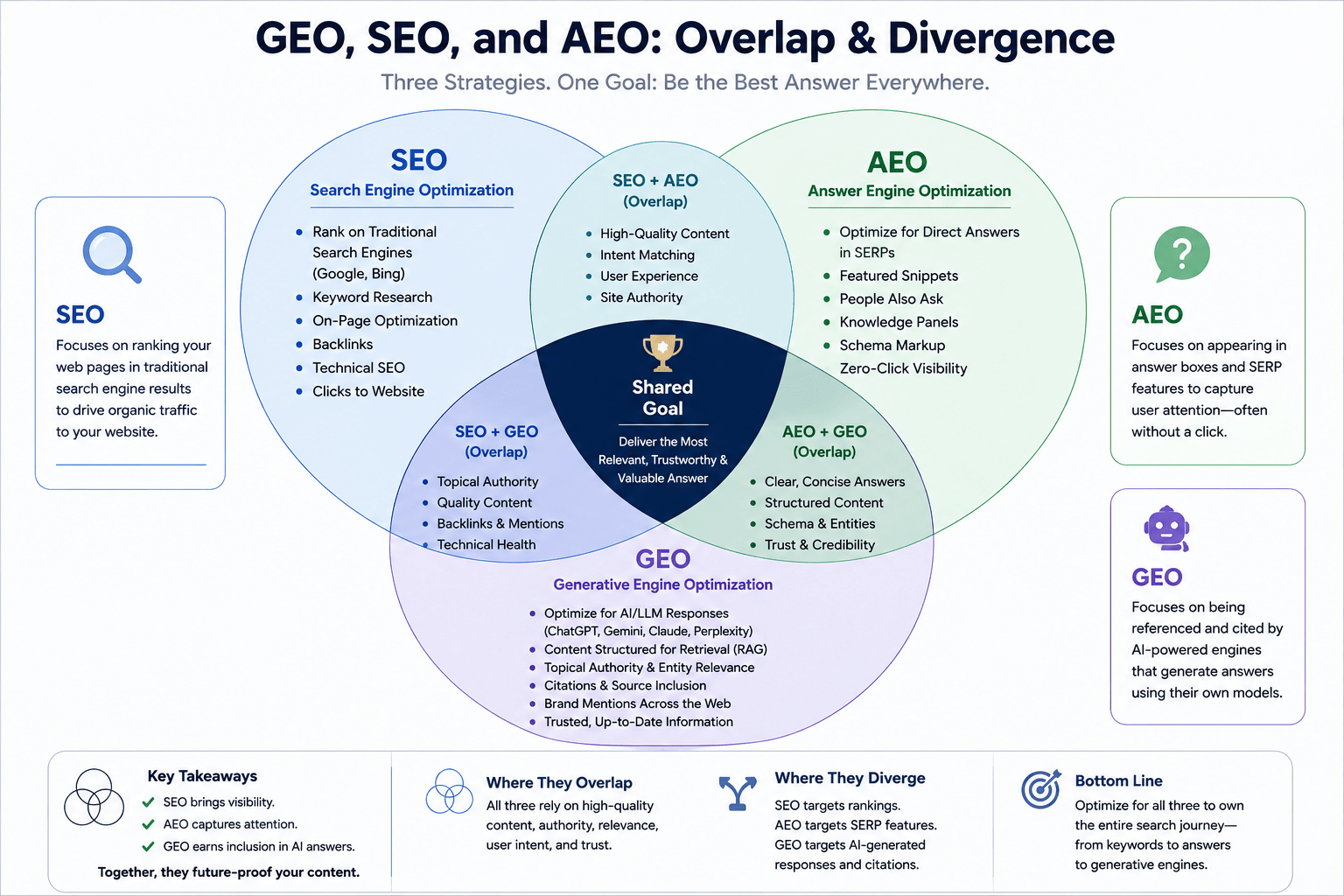
That’s the gap between SEO and GEO in a single paragraph. SEO gets you into the results. GEO gets you to the answer. And as the answer increasingly replaces the results for a growing category of queries, the two disciplines diverge in ways that matter practically.
This article explains exactly what that divergence looks like, where the two overlap, and what you actually need to do differently for each.
The Clearest Way to Understand the Difference
Before getting into mechanics, here’s the simplest framing possible.
SEO is about being on the shelf. GEO is about being recommended by the person behind the counter.
In a traditional bookshop, SEO is what gets your book stocked, displayed in a prominent position, and visible to browsers. The customer walks in, looks around, and finds you. Their discovery is self-directed.
GEO is what happens when the customer walks in, asks the bookseller, “What should I read about managing anxiety?”, and the bookseller reaches for your book specifically. The customer trusts the bookseller’s judgment. They take the recommendation without browsing the entire shelf.
That’s what AI-generated answers do. They make a recommendation. They name a source. They synthesize information from content they’ve assessed as trustworthy and relevant, and they present it to the user as a direct answer. The user doesn’t see the shelf. They see the recommendation.
Both outcomes are valuable. They’re just different and they require different things from your content.
How Search Actually Works in 2026
Understanding the difference between GEO and SEO requires understanding how fundamentally the search landscape has shifted in the last two years.
Traditional search the ten blue links is still happening. Google still indexes pages, ranks them, and shows them in results. That system hasn’t gone away, and it won’t disappear anytime soon. But it’s no longer the only meaningful way people find information online, and for a growing number of query types, it’s not even the primary way.
According to Semrush’s 2026 AI search trends report, AI Overviews now appear on approximately 48% of tracked queries up from 31% the previous year. That’s not a niche feature anymore. It’s the default experience for nearly half of all searches.
Meanwhile, Bain & Company research found that 60% of searches now end without a click to an external website. When an AI summary appears, only 8% of users click through to the cited sources compared to 15% when no summary is shown.
Gartner projected that traditional search engine volume would drop 25% by 2026 as conversational AI interfaces absorb more of that demand. The projection was made in 2024. Looking at the traffic patterns of 2025 and 2026, it wasn’t far off.
And beyond Google, entirely separate search ecosystems have emerged. ChatGPT processes over 800 million queries per week. Perplexity handles hundreds of millions more. These platforms don’t use the same ranking systems as Google. They have their own crawlers, their own evaluation criteria, and their own ideas about what constitutes a trustworthy source.
This is the landscape in which GEO and SEO now coexist.
What SEO Optimizes For And How It Works
Traditional SEO has been refined over twenty-five years, and its core logic is well understood even if its precise mechanics remain opaque.
Google’s algorithm evaluates pages on hundreds of signals, but the most significant ones cluster around a few core ideas. Authority Does this site have credibility, earned through backlinks from other authoritative sources? Relevance does this page genuinely address the query being searched? Experience is the page technically sound, fast to load, easy to use on any device? And trustworthiness does the content demonstrate real expertise and accuracy?
These signals feed into a ranking position. That position determines where your page appears in the list of results. A higher position generates more clicks. More clicks generate traffic. Traffic directly or indirectly generates revenue.
The optimization work in SEO is about influencing those signals. You build backlinks to improve authority. You research keywords to ensure relevance. You optimize page speed and mobile experience to improve technical quality. You demonstrate expertise through depth and accuracy of content.
Google’s own Search Quality Evaluator Guidelines a document that describes what Google wants its human quality raters to assess organize this around EEAT: Experience, Expertise, Authoritativeness, and Trustworthiness. These aren’t just abstract ideals. They’re the framework Google uses to evaluate whether content deserves to rank.
SEO success is measured in positions, clicks, impressions, and organic traffic. The feedback loop is relatively clear: rank higher, get more clicks, earn more traffic. Measurement tools Ahrefs, Semrush, and Google Search Console are mature and reliable.
What GEO Optimizes For And How It Works
GEO targets a different outcome in a different environment through different mechanisms.
The goal isn’t to rank in a list. It’s to be the source an AI system cites when it synthesizes an answer. That requires your content to pass a different set of tests tests that overlap with SEO in some areas and diverge sharply in others.
The technical foundation of most AI search platforms is something called Retrieval-Augmented Generation, or RAG. Princeton University researchers who coined the term “generative engine optimization” in 2023 were the first to formally study how this works from a content optimization perspective.
When a user submits a query, the AI doesn’t generate an answer purely from its training knowledge. It actively retrieves relevant documents from its index or from a live web crawl, depending on the platform evaluates them, and uses the best sources to construct a response. The response is generated, not retrieved. It’s a synthesis, not a copy. And it may or may not include explicit citations pointing back to the source material.
For your content to be cited in that response, it needs to pass the retrieval step and the evaluation step. Retrieval requires that AI crawlers can reach your page, that your content is semantically relevant to the query, and that it’s been indexed by the platform in question. Evaluation requires that your content is assessed as authoritative, accurate, fresh, and structurally extractable meaning the AI can pull specific facts and claims from it cleanly.
According to research published by Princeton’s GEO-BENCH project, the content characteristics that most reliably improve GEO visibility are: the presence of named statistics with sources (+33.9% visibility lift), direct quotations from named authorities (+30%), explicit citations within the content (+28%), and structural clarity and fluency (+28%).
GEO success is measured differently from SEO success. The metrics are citation frequency how often your brand or content appears in AI-generated answers AI share of voice relative to competitors, and the quality of AI referral traffic that converts when it does arrive. AI-referred visitors convert at approximately 14.2%, compared to 2.8% for standard organic search traffic, according to Frase.io’s internal data. The visitors who click through from AI citations are pre-qualified in a way that general organic traffic isn’t.
Where GEO and SEO Overlap
The overlap is more substantial than the “GEO vs SEO” framing might suggest. They’re not opposing disciplines. They share a foundation.
Content quality matters for both. Google’s ranking algorithms and AI citation systems both reward content that genuinely helps the person asking the question. Thin, superficial content performs poorly in both environments. Comprehensive, accurate, well-structured content performs well in both.
Technical accessibility is shared. A site that AI crawlers can’t reach is invisible to GEO. A site with poor technical SEO is invisible to Google. Many of the technical requirements overlap: fast load times, clean HTML, no blocking in robots.txt for relevant bots, proper indexation, and mobile-friendly rendering. Google confirmed in May 2026 that AI Overviews use the same core quality systems as regular Search, which means strong technical SEO directly feeds Google’s AI features.
EEAT signals apply to both. Experience, Expertise, Authoritativeness, and Trustworthiness are what Google’s quality raters evaluate for traditional rankings. They’re also what AI systems weigh when deciding which sources to trust. A page with strong EEAT signals named authors with verifiable credentials, accurate information, organizational credibility, appropriate citations performs better in both environments.
Topical authority compounds in both. A site that consistently publishes high-quality content on a focused topic builds authority in that topic area. That authority helps traditional rankings, and it helps AI citation preference. Research by Semrush has shown that topical authority having comprehensive, interconnected content coverage of a subject is increasingly a ranking factor in traditional search. The same coverage depth that builds topical authority also makes a site a more reliable citation target for AI systems.
Structured data helps both. Schema markup FAQPage, HowTo, Article, Organization helps Google understand content and display it in rich results. It also explicitly signals to AI crawlers what type of information each section contains, improving the likelihood of extraction and citation. Implementing a schema is rarely wasted effort; it pays dividends in multiple channels simultaneously.
Where They Genuinely Diverge
The differences are real, and they matter practically.
Different target platforms
SEO primarily targets Google, with secondary consideration for Bing, which powers a significant share of search traffic and is the underlying index for ChatGPT’s search functionality. GEO requires considering an additional set of platforms Perplexity, Claude, Gemini, Grok, Copilot each with its own crawlers, indexing behaviors, and citation preferences.
A 2026 study by Superlines analyzed 34,234 AI-generated responses across ten platforms and found that the same brand’s citation rate ranged from 0.59% on ChatGPT to 27% on Grok a 46-times difference. This isn’t a rounding error. It reflects genuinely different platform architectures and trust signals. GEO requires platform-level thinking that SEO never did.
Different content structure requirements
SEO has historically rewarded comprehensive content that demonstrates depth and covers a topic from multiple angles. That remains true. But the structure of that content matters differently for GEO.
AI systems retrieve content through semantic search and evaluate it for extractability. A dense, discursive essay might rank well in Google because it demonstrates depth, but extract poorly in an AI system because there’s no clear, direct answer to latch onto. GEO requires leading with the answer what’s sometimes called BLUF, Bottom Line Up Front and maintaining a structure where specific facts and claims are clearly delineated rather than buried in narrative prose.
Research from ALM Corp’s 2026 analysis found that 44.2% of all AI citations come from the first 30% of a piece of content. That single finding should change how you write introductions. It doesn’t mean shortening articles it means front-loading the most citable information rather than building to it.
Different backlink logic
In traditional SEO, backlinks are one of the most powerful ranking signals. A link from an authoritative site transfers credibility to the linked page and significantly influences ranking position. Backlink building is, for many SEO professionals, the primary off-page activity.
For GEO, the equivalent signal is third-party presence being mentioned, referenced, and cited across multiple authoritative platforms, not just linked to. According to Semrush’s AI agent analysis, sites present on four or more external platforms are 2.8 times more likely to appear in ChatGPT recommendations. That means Wikipedia mentions, podcast citations, press coverage, forum discussions, and academic references all contribute to GEO standing in ways they don’t directly translate to traditional PageRank.
Different freshness sensitivity
Google’s algorithm weights content freshness, but the penalties for staleness accumulate gradually. A well-established page can retain rankings for years with minimal updates, particularly for evergreen topics.
AI systems are more sensitive to recency. Frase.io’s research found that pages updated within 60 days are 1.9 times more likely to appear in AI citations than stale pages. AI visibility can drop 36% in just five weeks without content updates. This isn’t about rewriting articles constantly it’s about adding new statistics, updating outdated information, and refreshing the modified timestamp on a regular schedule.
Different measurement systems
SEO measurement is mature. Google Search Console gives you impressions, clicks, and positions. Ahrefs and Semrush give you ranking histories, backlink profiles, and traffic estimates. The data is imperfect, but the tools are well-established.
GEO measurement is still catching up. Citation frequency across AI platforms isn’t easily tracked without specialized tools. Semrush’s AI Visibility Toolkit offers platform-level citation monitoring. Superlines tracks AI share of voice across multiple platforms. Geoptie provides citation analytics alongside content optimization recommendations. These tools exist and are improving, but the measurement infrastructure for GEO is less standardized than what SEO practitioners have relied on for a decade.
Which One Should You Focus On?
The question is understandable, but it’s slightly the wrong frame. The real question is: what proportion of your audience’s searches are currently being answered by AI before they reach your site?
For some topics established, evergreen, low-urgency informational queries AI Overviews are appearing constantly, and optimizing only for traditional rankings misses a growing share of the potential audience.
For other topics highly specific, transactional, local, time-sensitive traditional search still dominates, and GEO’s contribution is more marginal in the near term.
A content strategist at a B2B SaaS company whose audience regularly searches for technical comparisons and implementation guides is operating in an environment where AI-generated answers are extremely common. GEO is urgently relevant.
A local plumbing company whose customers search for “emergency plumber near me” at 11pm is operating in an environment where traditional search, Google Maps, and local SEO still dominate. GEO matters, but it’s a secondary priority.
Honest assessment of your specific situation beats any blanket recommendation. Look at your top 20 target keywords. Run them in ChatGPT, Perplexity, and Google. See how often AI answers appear, whether competitors are being cited, and whether your content appears anywhere. That twenty-minute audit tells you more about your GEO exposure than any general framework.
The Combined Strategy That Actually Works
For most content-driven businesses in 2026, the practical answer is: both, with a shared foundation.
The foundation technically sound site, genuine topical expertise, strong EEAT signals, comprehensive content serves both disciplines simultaneously. You don’t build this foundation twice. You build it once, and it supports both traditional rankings and AI citation performance.
On top of that foundation, you add SEO-specific work (backlink building, keyword targeting, technical optimization) and GEO-specific work (BLUF introductions, named statistics, FAQ schema, freshness maintenance, multi-platform presence building) as complementary layers.
The budget and time allocation between them should reflect your audience’s actual search behavior. If your topics are AI-heavy meaning AI Overviews appear frequently for your target keywords shift more resource toward GEO. If your audience is still primarily discovering you through traditional search, maintain SEO as the priority while building GEO foundations.
The one thing to avoid is treating GEO as a replacement for SEO and abandoning the work that’s still generating traffic. Traditional search is declining as a share of total discovery, but it hasn’t declined to zero and won’t anytime soon. The smart position is both, managed proportionally.
Common Misconceptions Worth Clearing Up
“GEO will replace SEO.” It won’t. Google has confirmed that AI Overviews use the same core quality systems as traditional Search. Strong SEO supports GEO performance. They’re complementary, not competitive.
“If I rank #1, I’ll be cited in AI answers.” Not necessarily. Only 38% of AI citations come from top-10 organic results, according to research by Navoto. A page can rank well in traditional search and be invisible in AI citations if its structure doesn’t support AI extraction. And a lower-ranking page with strong GEO optimization can earn citations consistently despite not ranking in the top ten organically.
“GEO is just SEO with different terminology.” The shared foundation creates this impression, but the divergences are real. Different target platforms, different structural requirements, different freshness sensitivity, different measurement systems, and different off-page signals mean the implementation differs substantially even where the principles overlap.
“Small sites can’t compete in GEO.” This is probably the most important misconception to correct. In traditional SEO, domain authority accumulated over years through backlink building creates a significant structural advantage for established sites. In GEO, a domain rating of 30 can outperform a domain rating of 80 if the content structure is superior. The playing field is genuinely more level, particularly for sites that build topical depth in a focused niche.
“GEO is too new to prioritize.” The keyword difficulty for GEO-related topics averages KD 14–18 right now. Traditional SEO equivalents sit at KD 45–60. The competitive window is open in a way it hasn’t been for traditional SEO in years. Waiting for GEO to become mainstream means competing in a market where early movers have already established citation authority that compounds over time.
FAQ
What is the main difference between GEO and SEO?
SEO optimizes content to rank in traditional search result lists. GEO optimizes content to be cited in AI-generated answers. SEO targets Google’s ranking algorithm. GEO targets the retrieval and evaluation systems of AI platforms like ChatGPT, Perplexity, and Google AI Overviews.
Does GEO replace SEO?
No. GEO builds on SEO’s foundation. Strong technical SEO, genuine content quality, and EEAT signals all support GEO performance. The two disciplines are complementary, and abandoning SEO in favor of GEO would be a mistake for most businesses.
Can the same content work for both GEO and SEO?
Largely yes, with adjustments. The shared foundation comprehensive, accurate, well-structured content with strong EEAT signals serves both. GEO-specific additions include BLUF introductions, named statistics with sources, FAQ schema, and regular freshness updates.
Which platforms does GEO cover?
ChatGPT, Google AI Overviews, Google AI Mode, Perplexity AI, Gemini, Claude, Microsoft Copilot, and Grok are the primary platforms. Each has different crawlers, indexing behaviors, and citation preferences.
How do I know if GEO is urgent for my business?
Search your top 20 target keywords in ChatGPT, Perplexity, and Google. If AI-generated answers appear frequently, and if competitors are being cited in those answers, GEO is urgently relevant. If traditional search still dominates your category, GEO is a secondary priority.
Is GEO harder than SEO?
It’s different rather than harder or easier. Some elements are simpler structural content changes like BLUF introductions and FAQ schema are relatively low-effort. Others are more complex multi-platform presence building and citation tracking across AI platforms require new tools and workflows. The barrier to entry in terms of domain authority is lower for GEO than for competitive SEO.
What metrics measure GEO performance?
Citation frequency (how often your brand appears in AI-generated answers), AI share of voice relative to competitors, AI referral traffic volume in GA4, and conversion rate of AI-referred visitors.
How often do I need to update content for GEO?
More frequently than for traditional SEO. Pages updated within 60 days are 1.9 times more likely to appear in AI citations. A quarterly refresh schedule updating statistics, adding new information, and updating the dateModified timestamp is the minimum recommended cadence.
Does backlink building help GEO?
Indirectly. Backlinks contribute to domain authority and EEAT signals, which feed GEO performance. But the more direct GEO equivalent of backlink building is third-party presence genuine mentions and citations across multiple authoritative platforms, not just links. Both matter.
Is GEO relevant for e-commerce sites?
Increasingly. Google’s Universal Checkout Protocol allows users to complete purchases inside AI Mode. AI agents are beginning to research, compare, and transact on behalf of users. E-commerce sites that aren’t machine-readable with clear structured data, explicit product attributes, and accurate pricing risk being skipped entirely in agent-mediated purchase decisions.
The Bottom Line
GEO and SEO are not the same discipline. They share a foundation, they reinforce each other, and the best content strategy in 2026 incorporates both. But they target different systems, require different structural choices, measure success differently, and respond to different off-page signals.
The clearest way to think about it is this: SEO gets you on the shelf. GEO gets you recommended. Both matter. The proportion of your audience that discovers you through AI answers versus traditional search results determines how much energy to direct at each.
That proportion is growing in favor of AI discovery for most content categories. The time to build GEO foundations is now, while the competitive field is still open.