


If you’re here, chances are you’re curious about this topic or you’re a fellow blogger trying to figure out what’s happening to your website traffic.
You may have noticed something unusual. Your rankings still look good. Your content is on the first page of Google. Yet the visitors just aren’t coming like they used to. Clicks have dropped. Sessions are declining. Your Ahrefs traffic graph is heading in the wrong direction.
Then you search for one of your target keywords and realize something has changed. Instead of your article appearing first, Google shows its own AI-generated summary that answers the user’s question before they ever have a reason to click your website.
At first, you might think it’s a bug. I did too.
But it isn’t. Over the past few months, I’ve watched articles that consistently ranked on the first page lose clicks, even though their rankings barely changed. It wasn’t because the content had become outdated or competitors had overtaken it. The way people search has changed. AI now answers many questions directly on the search results page, meaning users often get what they need without ever visiting a website.
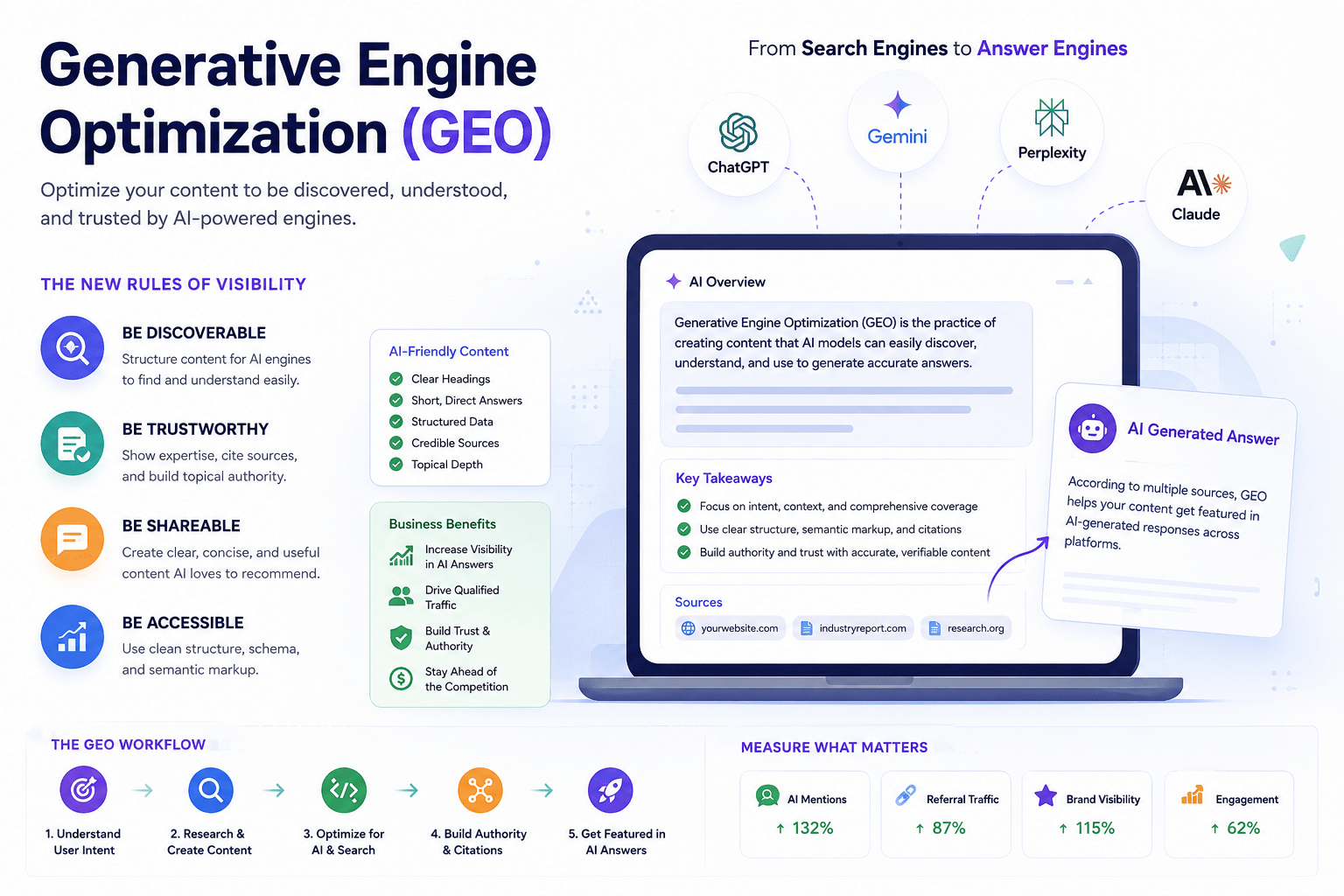
This shift has given rise to Generative Engine Optimization (GEO). GEO isn’t just another marketing buzzword or a new name for SEO. It’s a different way of thinking about content. Instead of optimizing only to rank in search results, you’re optimizing to become a trusted source that AI systems choose to cite, summarize, and recommend.
In this guide, I’ll explain what GEO really is, how it differs from traditional SEO, why it matters more than ever, and the practical strategies I’ve been using to help content remain visible in the age of AI-powered search.
The Simple Version First
Let’s keep it simple.
Generative Engine Optimization (GEO) is the practice of creating and structuring content so AI-powered search engines and assistants like ChatGPT, Google AI Overviews, Perplexity, Gemini, Claude, and Microsoft Copilot can easily understand, trust, and cite it when answering users’ questions.
That’s the entire idea behind GEO.
For years, the goal of SEO was straightforward: How do I rank #1 on Google?
Today, there’s a new question every content creator should be asking:
When someone asks an AI about my topic, will it use my content as part of the answer?
That single shift changes how we think about content.
A page can rank at the top of Google’s search results yet receive fewer clicks because users get their answers directly from AI Overviews. At the same time, another page with modest search rankings may be frequently referenced by AI systems because it provides clear explanations, trustworthy information, and well-structured content.
I’ve seen this happen on my own websites. Some articles maintained their rankings but experienced noticeable drops in traffic after AI-generated answers became more prominent. The issue wasn’t poor SEO. It was that the way people discover information had changed.
SEO and GEO are closely connected, but they serve different purposes.
SEO helps people find your content.
GEO helps AI find, understand, and recommend your content.
The websites that succeed over the next few years won’t choose one over the other. They’ll combine both strategies to stay visible wherever people search for answers.
Why Is This Happening Now?
This shift didn’t happen overnight, and it certainly isn’t accidental. Over the last two years, the way people search for information has changed faster than at any point since Google became the default search engine.
Instead of typing a keyword, opening multiple websites, and comparing answers, people are increasingly asking AI assistants a question and accepting the first well-structured response they receive.
Platforms like ChatGPT, Google AI Overviews, Perplexity, Gemini, Claude, and Microsoft Copilot have become part of everyday search behavior. Millions of users now rely on them to summarize complex topics, compare products, explain concepts, and even make purchasing decisions.
When I first noticed my website traffic declining, I assumed my rankings had slipped. They hadn’t. The articles were still performing well in traditional search. What had changed was how users consumed information. Google was answering questions directly on the results page, and AI assistants were generating complete responses without requiring users to visit individual websites.
This isn’t just my experience. Industry data points to the same trend.
Research from Gartner projected that traditional search volume could decline by 25% by 2026 as users shift toward conversational AI. At the same time, Google AI Overviews are reaching billions of users each month, while ChatGPT handles hundreds of millions of queries every week. AI-powered search is no longer an experiment. It’s becoming a mainstream way people find information.
The biggest impact is on website traffic.
A growing percentage of searches now end without the user clicking on any website. Instead, they read the AI-generated answer and move on. That means even if your article ranks on the first page, it may receive far fewer visitors than it did just a year ago.
I’ve seen this across my own websites. Articles that consistently ranked well continued to hold their positions, but clicks and sessions steadily declined. The content hadn’t become worse. User behavior had changed.
Publishers around the world have reported similar experiences, with many seeing significant drops in organic traffic after AI-generated answers became more prominent in search results. This isn’t a temporary fluctuation or an isolated issue. It’s part of a broader transformation in how search engines deliver information.
The good news is that this change also creates an opportunity.
Instead of optimizing only for rankings, content creators can now optimize for citations. The goal is no longer just to appear in search results but to become one of the trusted sources AI systems use when generating answers.
That’s exactly what Generative Engine Optimization (GEO) is designed to help you achieve.
Those who understand this shift early will have a significant advantage. As more publishers begin optimizing for AI search, competition will increase, making it much harder to establish authority later. Just as early adopters benefited from traditional SEO, today’s early adopters of GEO have the opportunity to build visibility before the space becomes crowded.
What GEO Actually Looks Like in Practice
Let me give you a practical example.
Imagine someone asks Perplexity:
“What’s the best way to reduce churn for a B2B SaaS product?”
Instead of showing ten blue links like a traditional search engine, Perplexity generates a complete answer by combining information from several trusted sources. It may reference three or four articles, include inline citations, and provide a concise explanation that satisfies the user’s query.
The user reads the answer, finds it useful, and often leaves without opening multiple websites. Sometimes they’ll click one of the cited sources to explore the topic further, but only if that source appears particularly credible or offers additional value.
Now imagine your SaaS blog has a well-written article on reducing churn.
It opens with a clear answer instead of a lengthy introduction. It includes practical frameworks, original insights from your experience, relevant statistics, descriptive headings, and answers to common follow-up questions. Because the content is easy for AI to understand and trust, there’s a good chance Perplexity or another AI assistant will cite it as one of the sources used to generate its response.
That’s exactly what GEO is designed to achieve.
What I Learned From My Own Websites
I didn’t fully understand this until I started experimenting with Buddymantra and a few of my other websites.
Like many bloggers, my first instinct was to focus on rankings. If an article reached the first page of Google, I considered it successful. But over time, I noticed something strange. Some of my best-performing articles were still ranking well, yet traffic kept falling.
Curious about what was happening, I began searching the same topics in ChatGPT, Google AI Overviews, and Perplexity.
That’s when everything clicked.
The AI wasn’t looking for the page with the most keywords. It was looking for the page that answered the question clearly, backed up its claims, and was easy to extract information from.
So I changed the way I wrote.
Instead of lengthy introductions, I started answering the main question immediately. I added comparison tables, FAQs, original diagrams, practical examples, and internal links between related articles. I stopped writing only for Google’s ranking algorithm and started writing for both humans and AI systems.
Within weeks, I began seeing my content appear as cited sources in AI-generated answers for several topics. The referral traffic wasn’t always massive, but the visitors who arrived were far more engaged because they already trusted the content after seeing it referenced by an AI assistant.
That completely changed my perspective.
Today, I don’t measure success only by whether an article ranks #1. I also ask myself:
- Will an AI understand this page?
- Is the answer clear enough to quote?
- Does it provide something original that other articles don’t?
- Would I trust this article if I were an AI selecting sources?
Those questions now shape every article I publish.
Because that’s what GEO is really optimizing for.
Not just rankings.
Not even just clicks.
It’s about becoming a trusted source that AI platforms choose to reference, recommend, and cite whenever someone asks a question in your area of expertise.
In the AI-first era of search, being cited is becoming just as valuable as being ranked.
GEO vs SEO vs AEO Let’s Clear This Up
These three terms get tangled constantly, so it’s worth taking a moment to separate them.
SEO is what most people know. You optimize your content so Google ranks it near the top of its results page. You think about backlinks, page speed, keyword density, and domain authority. Success means appearing in the list.
AEO answer engine optimization is a narrower discipline focused on winning featured snippets, People Also Ask boxes, and voice search results within Google’s traditional search interface. It’s about getting your content into those boxed-out answer panels that appear above the regular results.
GEO operates across a completely different set of platforms. ChatGPT. Perplexity. Google AI Mode. Claude. Gemini. Microsoft Copilot. These systems generate synthesized answers rather than lists of links, and they have their own crawlers, their own ranking signals, and their own preferences for what content they cite.
The most important thing to understand is that GEO doesn’t replace SEO. It builds on it. A technically broken website that AI bots can’t crawl won’t earn citations regardless of how well it’s written. Strong technical SEO, genuine topical depth, and real EEAT signals still matter they’re table stakes. GEO is what you add on top.
Google made this explicit in May 2026, publishing guidance confirming that AI Overviews and AI Mode use the same core quality systems as traditional Search. The difference is in the additional signals that determine whether AI specifically wants to cite you.
How AI Engines Decide What to Cite
This is the part that most GEO articles skip, but in my opinion, it’s the most important one.
Once you understand how AI engines choose their sources, almost every GEO strategy starts to make sense.
When I first started optimizing content for AI search, I assumed platforms like ChatGPT and Perplexity simply searched the web the way Google does. The reality is much more sophisticated.
Most modern AI search engines use a technique called Retrieval-Augmented Generation (RAG).
Don’t let the technical name intimidate you.
The concept is actually quite simple.
When you ask an AI a question, it doesn’t rely only on what it learned during training. Instead, it searches for relevant and up-to-date information, evaluates multiple sources, and then generates a response based on the best information it finds.
Think of it as an AI researcher rather than a traditional search engine.
Step 1: Breaking Your Question Into Smaller Questions
One thing that surprised me while studying AI search is that it rarely treats your query as a single search.
Instead, it breaks it into several smaller questions, a process often called query fan-out.
For example, if someone asks:
"What's the best VPN for streaming Netflix in Europe?"
The AI may internally search for things like:
- Best VPNs in 2026
- VPNs that work with Netflix
- Fast VPNs for streaming
- VPN server locations in Europe
- VPN privacy and security
Instead of finding one perfect article, it gathers information from multiple sources that answer each part of the question.
That’s why a narrowly focused article often struggles to get cited. AI prefers content that answers the main topic and the related questions users are likely to have.
Step 2: Finding the Most Relevant Content
Unlike traditional search engines that relied heavily on exact keywords, AI systems use semantic search.
In simple terms, they try to understand the meaning behind your content rather than matching identical words.
For example, an article titled “How Businesses Can Reduce Customer Churn” can still be selected for someone searching “Ways to improve customer retention,” even if the exact phrase doesn’t appear throughout the article.
That’s one reason I’ve stopped obsessing over exact-match keywords.
Instead, I focus on explaining topics comprehensively and using natural language that answers related questions.
Step 3: Evaluating Whether Your Content Can Be Trusted
After finding relevant pages, AI systems still have another decision to make.
Which sources deserve to be cited?
Although companies don’t publish their exact algorithms, most AI platforms appear to consider factors such as:
- Relevance to the user’s question
- Depth and completeness of the content
- Accuracy and factual consistency
- Freshness of the information
- Website authority
- Clear structure and readability
- Evidence, statistics, and credible references
This explains why two articles covering the same topic can have very different outcomes.
One may rank well on Google but never appear in AI-generated answers.
Another may receive fewer traditional search visits yet be cited regularly because it’s easier for AI to understand and trust.
Step 4: Generating the Final Answer
Once the AI has selected its sources, it doesn’t simply copy paragraphs from each website.
Instead, it combines information from multiple sources, rewrites it in its own words, and presents a single, conversational answer.
When supported, platforms like Perplexity and Google AI Overviews include citations so users can see where specific information came from.
This is where GEO becomes so valuable.
Your objective isn’t to have AI copy your content.
Your goal is to make your content so useful, well-structured, and trustworthy that it becomes one of the sources AI chooses to learn from while generating its answer.
The Biggest Lesson I Learned
One of the biggest changes I’ve made on Buddymantra is thinking less like a blogger and more like an editor preparing information for both people and machines.
A few years ago, I would write long introductions, hoping readers would stay with me until I reached the answer.
Today, I do the opposite.
I answer the main question immediately, use descriptive headings, break complex topics into smaller sections, add comparison tables where appropriate, include FAQs, and support important claims with reliable sources.
Not because Google demands it.
Because AI systems can understand and extract that information far more effectively.
The lesson is simple.
A beautifully written article that hides the answer halfway through may impress human readers, but it can be difficult for AI to process.
A well-organized article that answers questions clearly, uses logical headings, provides evidence, and covers related subtopics gives AI exactly what it needs.
And in the age of AI search, that’s increasingly the difference between simply publishing content and becoming a source that AI chooses to cite.
The 7 GEO Strategies That Actually Worked for Me
Enough theory.
Let’s talk about what I’ve been doing on Buddymantra after realizing that traditional SEO alone wasn’t enough anymore.
Some of these changes took less than 30 minutes to implement. Others required me to completely rethink how I write articles. But together, they’ve changed my content strategy.
1. Make Sure AI Can Actually Access Your Website
This sounds obvious, but it’s the first thing I checked.
After reading about AI crawlers, I opened my website’s robots.txt file and Cloudflare settings.
To my surprise, many website owners have unknowingly blocked AI crawlers like GPTBot, PerplexityBot, ClaudeBot, or Google-Extended.
If AI can’t crawl your content, it can’t cite it.
Before worrying about prompts, schema, or AI optimization, make sure these crawlers are actually allowed to access your site.
I also added an llms.txt file to Buddymantra.
Think of it as a sitemap built specifically for AI. It’s still an emerging standard, but I believe it’s worth implementing now rather than waiting until everyone else catches up.
2. Stop Writing Long Introductions
This was probably the hardest habit for me to break.
Like many bloggers, I loved building suspense before answering the main question.
But AI doesn’t.
If your article spends 600 words explaining the history before finally answering the question, chances are an AI system will move on to another source.
Now every article I publish starts like this:
- Answer the question.
- Explain it simply.
- Then go into the details.
I’ve noticed this also improves the reader experience. Visitors don’t have to scroll endlessly to find what they came for.
3. Add Facts That AI Can Trust
One thing I’ve noticed while researching AI-generated answers is that they love specific facts.
Instead of writing:
SEO is changing quickly.
Write:
According to Gartner, traditional search volume is expected to decline as conversational AI adoption grows.
Instead of saying:
Studies show...
Mention who conducted the study.
Instead of saying:
Experts believe...
Name the expert.
Specific numbers and named sources make your content much easier for AI to trust and reference.
4. Use Real Expert Quotes
Whenever possible, include quotes from people who are recognized in your industry.
You don’t need to interview them yourself.
Many experts publish research, appear on podcasts, or share insights on LinkedIn.
Quote them properly.
Attribute them clearly.
It makes your article more credible for both readers and AI.
5. Add FAQ and Structured Data
I’ve been using FAQ schema on most of my important articles.
Not because it magically boosts rankings.
Because it organizes information in a way machines can understand.
A question.
A clear answer.
Repeat.
That’s exactly how people interact with AI assistants today.
If your CMS supports schema plugins, there’s really no reason not to use them.
6. Build Authority Beyond Your Own Website
This is something I completely underestimated.
AI doesn’t only evaluate what’s written on your website.
It also looks at how often your brand is mentioned elsewhere.
That means:
- Guest posts
- Podcasts
- Interviews
- Reddit discussions
- Industry publications
- LinkedIn articles
- Research reports
The more places your expertise appears naturally, the stronger your overall authority becomes.
That’s one reason I’m investing more time in publishing original research and sharing insights across different platforms instead of relying solely on Google traffic.
7. Refresh Your Best Content Regularly
One mistake I made was publishing an article and forgetting about it.
Now I schedule regular reviews of my cornerstone content.
Every few months, I:
- Update statistics.
- Add new screenshots.
- Improve examples.
- Expand FAQs.
- Add internal links.
- Refresh the publication date when meaningful updates are made.
Think of your content like software.
If you never update it, eventually it becomes outdated.
AI systems generally prefer content that reflects current information.
Every AI Platform Is Different
One mistake I see bloggers making is treating every AI platform as if it works exactly like Google.
It doesn’t.
Google AI Overviews still rely heavily on Google’s search index, so traditional SEO remains extremely important.
Perplexity tends to reward clear structure, recent information, and fast-loading pages.
ChatGPT Search can browse the live web for many queries, making Bing indexation and strong content quality increasingly important.
Claude appears to focus heavily on factual accuracy and clear writing rather than marketing language.
That’s why I no longer optimize for just one platform.
I write content that is useful enough to be cited regardless of where people search.
How I Measure GEO Success
Unlike SEO, GEO doesn’t yet have perfect reporting tools.
So I’ve started tracking it manually.
Every month I search my target topics in ChatGPT, Perplexity, Google AI Overviews, Gemini, and Claude.
I ask questions my readers would ask.
Then I note:
- Is Buddymantra mentioned?
- Which competitors are cited?
- What information is AI using?
- What can I improve?
It takes about 20 minutes every month.
But it tells me far more than obsessively checking keyword rankings every day.
Mistakes I Would Avoid
If you’re just getting started with GEO, avoid these common mistakes.
- Blocking AI crawlers without realizing it.
- Hiding the answer halfway through the article.
- Publishing content without original insights.
- Ignoring schema markup.
- Never updating old articles.
- Writing only for Google instead of writing for both humans and AI.
The biggest lesson I’ve learned is this:
Good SEO gets your page indexed.
Great GEO gives AI a reason to trust and recommend it.
That’s becoming one of the biggest competitive advantages in modern search.
Where GEO Is Heading
The next evolution is agentic AI systems that don’t just answer questions but complete tasks on your behalf. Google’s Universal Checkout Protocol, launched in early 2026, lets users buy products without leaving AI Mode. McKinsey estimates AI agents could mediate between three and five trillion dollars in commerce by 2030.
For content and e-commerce sites, this means that machine-readable product information, accurate descriptions, explicit pricing, and clear availability signals aren’t just nice to have. They’re prerequisites for appearing in agent-driven purchase decisions. An agent evaluating options for a user won’t dig through a poorly structured product page. It’ll move to the next result.
The brands building GEO foundations now are building something more durable than a traffic strategy. AI platforms show source preference bias once a system has found a source reliable for a specific topic area, it preferentially returns to that source for related queries. That flywheel, once established, is genuinely hard for competitors to disrupt.
FAQ
What is generative engine optimization?
It’s the practice of optimizing your content to be cited by AI search platforms ChatGPT, Perplexity, Google AI Overviews, Gemini, and others when they generate answers to user questions.
Is GEO the same as SEO?
No, though they share a foundation. SEO optimizes for rankings in traditional search results. GEO optimizes for citations in AI-generated answers. Strong SEO supports GEO, but GEO requires additional, specific optimizations.
How long does it take to see results?
Structural changes fixing crawler access, rewriting introductions, and adding schema can show measurable citation improvements within four to eight weeks on platforms that use live crawling. Platforms dependent on training data snapshots update more slowly.
Does GEO require a big budget?
Not at the start. Fixing crawler access, rewriting intros to lead with direct answers, and adding FAQ schema are all free. Third-party presence building costs more time than money. Paid monitoring tools become valuable at scale.
What content types work best?
How-to guides, comparison articles, FAQ pages, and original research consistently perform well. Depth matters content over 2,900 words earns significantly more AI citations on average but only when combined with clear structure.
Can small websites compete?
Yes, and more readily than in traditional SEO. A site with a domain rating of 30 can outperform a DR 80 competitor in AI citations if its content structure is superior. GEO rewards clarity and extractability more than raw authority metrics.
Which schema types should I prioritize?
FAQPage schema for FAQ sections, HowTo schema for step-by-step guides, Article schema with explicit published and modified dates, and Organization schema on your About page to strengthen brand entity clarity.
How do I track AI traffic?
Set up custom channel groups in GA4 to separate traffic from chat.openai.com, perplexity.ai, gemini.google.com, and claude.ai. Run manual citation audits monthly. Use tools like Semrush’s AI Visibility Toolkit for automated tracking.
What is query fan-out?
It’s how AI systems break a single user question into multiple smaller sub-queries before searching for information. Your content needs to address these sub-questions, not just the headline topic, to be retrieved across the full scope of a query.
Is GEO relevant for local businesses?
Increasingly. AI Mode’s agentic capabilities surface local business information in response to queries like “best Italian restaurant near me” or “emergency plumber open now.” Accurate, structured local data consistent NAP information, Google Business Profile, review schema feeds local GEO visibility.
What to Do This Week
If you’ve read this far and want to start somewhere, start with the simplest possible thing: open your robots.txt file and confirm that GPTBot, PerplexityBot, and Google-Extended are allowed. If they’re blocked, remove the restriction. That single change could restore AI visibility you’ve been losing for months without knowing it.
After that, pick your three most important articles and rewrite the first paragraph of each to lead with a direct answer to the question the article is supposed to answer. Add their word counts to a tracking spreadsheet. Schedule a reminder to refresh them in 60 days.
Then implement the FAQPage schema on those same three articles. If your CMS has a schema plugin, this is probably a one-hour task.
Three things. That’s a meaningful start.
GEO isn’t a replacement for everything you’ve already built. It’s the next layer. And right now, while the majority of content on the web is still ignoring it, that layer is easier to claim than it will ever be again.