



Even after completing their graduation, students often have to massively struggle to find jobs aligned to their educational background. That’s why even after spending 3-4 years completing a degree in a specific field, many students switch their career paths and have to start anew with a completely different area. One of the major reasons for this is the gap between what one is taught and what the industry demands of them. The Economic Survey 2024-25 notes that a significant share of the workforce enters the labour market without job-ready skills. As per Niti Aayog’s report Reimagining Skilling for Viksit Bharat@2047 (2026), only 8.25% of graduates are employed in roles aligned to their qualifications, and limited exposure to practical learning and industry-aligned training is one of the main reasons constraining employability.
What Do You Need for a Career in Accounting?
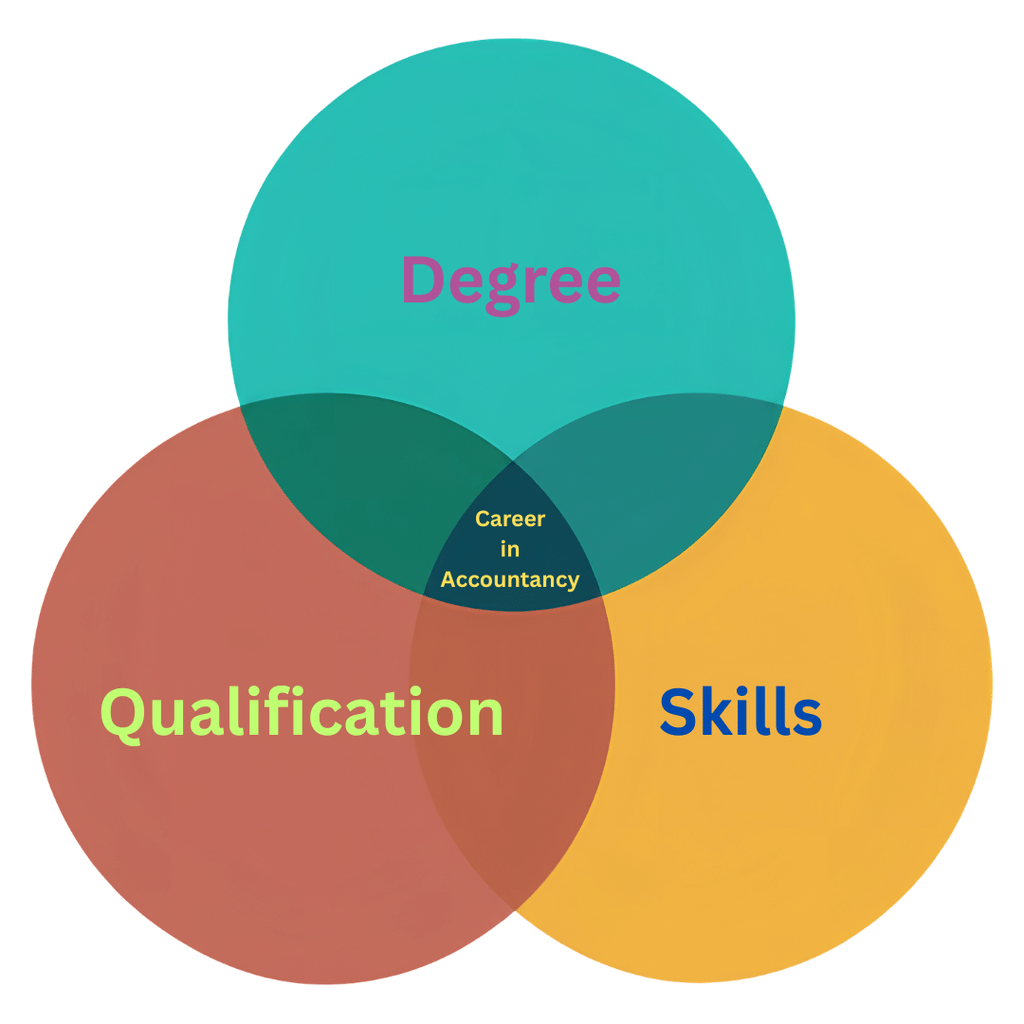
It’s a common misconception among students that all they need for a successful career in the field of accounting is a degree in commerce. Although a Bachelor of Commerce degree is important for a career in accounting, it’s not enough to get a reputed job in a MNC or GCC. There are other important factors too.
A Degree in Commerce
Having a degree in commerce (B.com) is crucial for a career in the field of accounting. It’s often considered a primary criteria (preferred but not mandatory) as it acquaints one with the concepts essential to developing an understanding of accounting.
Internationally-Recognised Accountancy Qualification
For a career in accounting, it’s important for students to earn a recognised professional accountancy qualification such as Indian CA, UK ACCA or US CPA as these accountancy qualifications are important to demonstrate that the student meets an internationally recognized professional standard.
Market Skills
In today’s fast-paced times, skills play a highly crucial role in the job market. To get an accounting job in a GCC (global capability center), one should have both technical as well as high-in-demand soft skills such as Advanced Excel, Power BI, ERP Systems, Tally, AI automation, IFRS or GAAP knowledge, and professional English communication, among others.
Indian CA (Chartered Accountant)

CA (Chartered Accountant) is one of the premier qualifications for a career in accounting. It is an Indian qualification regulated by the Institute of Chartered Accountants of India (ICAI), a statutory body set up under the Chartered Accountants Act, 1949. Although it’s mainly India-specific, it is globally recognised; but in case of countries other than India, one is usually required to take additional exams or get local licensing. The CA qualification equips professionals with advanced expertise in accounting, taxation, finance, and auditing.
Structure of CA
A Chartered Accountant (CA) program is split into 3 levels, i.e., foundational level, intermediate level and final level.
Foundational Level
At the foundational level, one is taught the basics of accounting, law, mathematics and economics. Any student who has completed their senior secondary education (Class 12 or equivalent from a recognized board) is eligible to get enrolled in the foundational level of CA.
The CA foundation course has the following four papers:
- Principles and Practice of Accounting
- Business Laws and Business Correspondence and Reporting
- Business Mathematics, Logical Reasoning and Statistics
- Business Economics and Business and Commercial Knowledge
Before appearing for a CA foundation level exam, one gets a 4-month study period.
Intermediate Level
The CA intermediate level is divided into 2 groups, each consisting of 3 papers.
Group 1 consists of the following 3 papers:
- Advanced Accounting
- Corporate and Other Laws
- Taxation
Group 2 consists of the following 3 papers:
- Cost and Management Accounting
- Auditing and Ethics
- Financial Management and Strategic Management
After passing all the exams of both groups of CA intermediate level, one has to do a mandatory 2-year (24 months) articleship under a practicing chartered accountant or a recognised CA firm, meeting the requirement of working 35 hours per week under close supervision.
Please note if one decides to leave CA after completing one’s articleship and decides not to continue to the final level, one will officially be considered a semi-qualified CA, and can leverage one’s practical experience for corporate jobs, though one can’t sign audits or practice as a CA without clear the final level.
Final Level
The final level of CA is the advanced level that requires one to clear 6 exams, divided into 2 groups.
Group 1 consists of the following 3 papers:
- Financial Reporting
- Advanced Financial Management
- Advanced Auditing, Assurance and Professional Ethics
Group 2 consists of the following 3 papers:
- Direct Tax Laws & International Taxation
- Indirect Tax Laws
- Integrated Business Solutions (Multidisciplinary Case Study with Strategic Management)
UK ACCA (Association of Chartered Certified Accountants)

UK ACCA (Association of Chartered Certified Accountants) is a globally recognised professional accountancy qualification offered by the Association of Chartered Certified Accountants, a UK-based professional accountancy body. Unlike Indian CA, ACCA is designed with an international focus and is recognised across 180+ countries, including hotspots like the UK, UAE, Singapore, Canada, Australia, New Zealand, and India, making it a highly suitable option for students who want to build a career in accounting, audit, taxation and finance with global companies, MNCs and GCCs.
Structure of ACCA
The ACCA qualification consists of a total of 13 papers. In case of B.Com graduates, there is an exemption of 5 papers, and so they have to give only 8 papers.
The 13 papers of ACCA are divided into three levels:
Level 1: Applied Knowledge
This level introduces students to the fundamental concepts required for a career in accounting and finance. This level consists of the following 3 papers:
- Business and Technology
- Management Accounting
- Financial Accounting
Level 2: Applied Skills
This level focuses on developing a deeper understanding of accounting and finance and includes areas such as taxation, financial reporting, auditing and financial management. This level consists of the following 6 papers:
- Corporate and Business Law
- Performance Management
- Taxation
- Financial Reporting
- Audit and Assurance
- Financial Management
Level 3: Strategic Professional
This level focuses on advanced technical knowledge, professional judgement and the ability to apply accounting concepts to complex business situations. This level consists of 2 mandatory papers and 2 compulsory optional papers that one has to choose from 4 options.
Following are the 2 mandatory papers:
- Strategic Business Reporting
- Strategic Business Leader
From the following 4 options, one has to choose any 2 options:
- Advanced Financial Management
- Advanced Performance Management
- Advanced Taxation
- Advanced Audit and Assurance
For a B.Com graduate who receives 5 exemptions, the remaining 8 exams can be divided into 4 trimesters, with 2 exams per trimester.
US CPA (Certified Public Accountant)
The US CPA (Certified Public Accountant) is a professional accounting qualification associated with the United States and is regulated through the state boards of accountancy. It is particularly relevant for students and accounting professionals who want to work with US accounting, auditing, taxation and financial reporting requirements.
Unlike Indian CA and UK ACCA, the US CPA is not a single qualification governed by one national licensing authority. CPA licensure is granted by individual US state boards, which means that eligibility requirements can vary depending on the state in which a candidate applies.
The US CPA is particularly relevant for professionals who want to work with US GAAP, US auditing standards and US taxation. This can make it a suitable career path for candidates targeting companies, accounting firms, MNCs and GCCs that have operations or reporting requirements connected to the United States.
Structure of US CPA
The US CPA exam runs on a core+discipline model, with 3 mandatory core sections and 1 discipline section (to be chosen from 3 options).
Following are the 3 mandatory core sections:
- Auditing and Attestation (AUD)
- Financial Accounting and Reporting (FAR)
- Regulation (REG)
For the discipline section, one has to choose any one option from the following three options:
- One Discipline section selected from Business Analysis and Reporting (BAR)
- Information Systems and Controls (ISC)
- Tax Compliance and Planning (TCP)
The CPA exam focuses heavily on financial reporting, auditing, taxation, regulation and business-related knowledge. However, meeting the educational and other eligibility requirements is an important part of CPA, and these requirements should be checked according to the specific US jurisdiction in which a candidate intends to apply.
CA vs ACCA vs US CPA: A Quick Comparison Table
| Feature | CA | ACCA | CPA |
| Full Form | Chartered Accountant | Association of Chartered Certified Accountants | Certified Public Accountant |
| Country or Origin | India | UK | USA |
| Global Recognition | Moderate | Very High (180+ countries) | High |
| Eligibility | 12th pass or B.Com graduate | 12th pass + Foundation or Graduation | Graduation + 120 credit hours (B.Com + M.Com/MBA) |
| Duration | 4-5+ years | 2-3 years | 1-1.5 years |
| No. of Papers | 13 | 13 (with exemptions possible) | 4 |
| Focus Area | Indian Accounting, Taxation, Audit, Finance | IFRS, Global Finance, Auditing | US GAAP, Taxation, Auditing |
| Difficulty Level | Very high | Moderate | Moderate to High |
| Cost | ₹1.5 – ₹2.5 lakhs (approx.) | ₹2.5 – ₹3.5 lakhs (approx.) | ₹2.8 – ₹3.5 lakhs (approx.) |
CA vs ACCA vs US CPA: Which One is Better?
When it comes to choosing among Indian CA, UK ACCA and US CPA, there is no one single answer to which qualification is better. This is because the right choice depends largely on the student’s career goals, preferred geography and the type of accounting work they want to pursue in future.
If a student wants to build a long-term accounting career primarily in India, Indian CA can be a strong choice. It provides extensive exposure to Indian taxation, auditing, accounting and corporate laws and is particularly relevant for students who want to work in areas such as statutory audit, taxation, financial reporting or professional practice in India.
UK ACCA can be a great option for students who want an internationally oriented accounting qualification and are interested in working with MNCs, GCCs or companies operating across different countries as it provides access to 180+ countries, including hotspots like the UK, UAE, Singapore, Canada, Australia, New Zealand, and India. The qualification benefit doubles when ACCA is offered through an institution that has active placement partnerships with GCCs and Big Four firms. Its international focus can also make it relevant for students who want to build careers around IFRS, financial reporting, audit and global finance functions. For B.Com graduates who receive exemptions, the reduced number of exams can also make the qualification more manageable.
US CPA is generally more suitable for students who specifically want to work with US accounting and reporting. It can be particularly relevant for candidates targeting organisations that work extensively with US GAAP, US audits, US taxation or US-based clients.
In conclusion, CA, ACCA and US CPA, all are recognised and reputed qualifications with huge significance and neither can be termed as superior to the rest. So, students should always figure out their career goals, preferred geography and type of work they want to do in the future first before choosing the certification.