

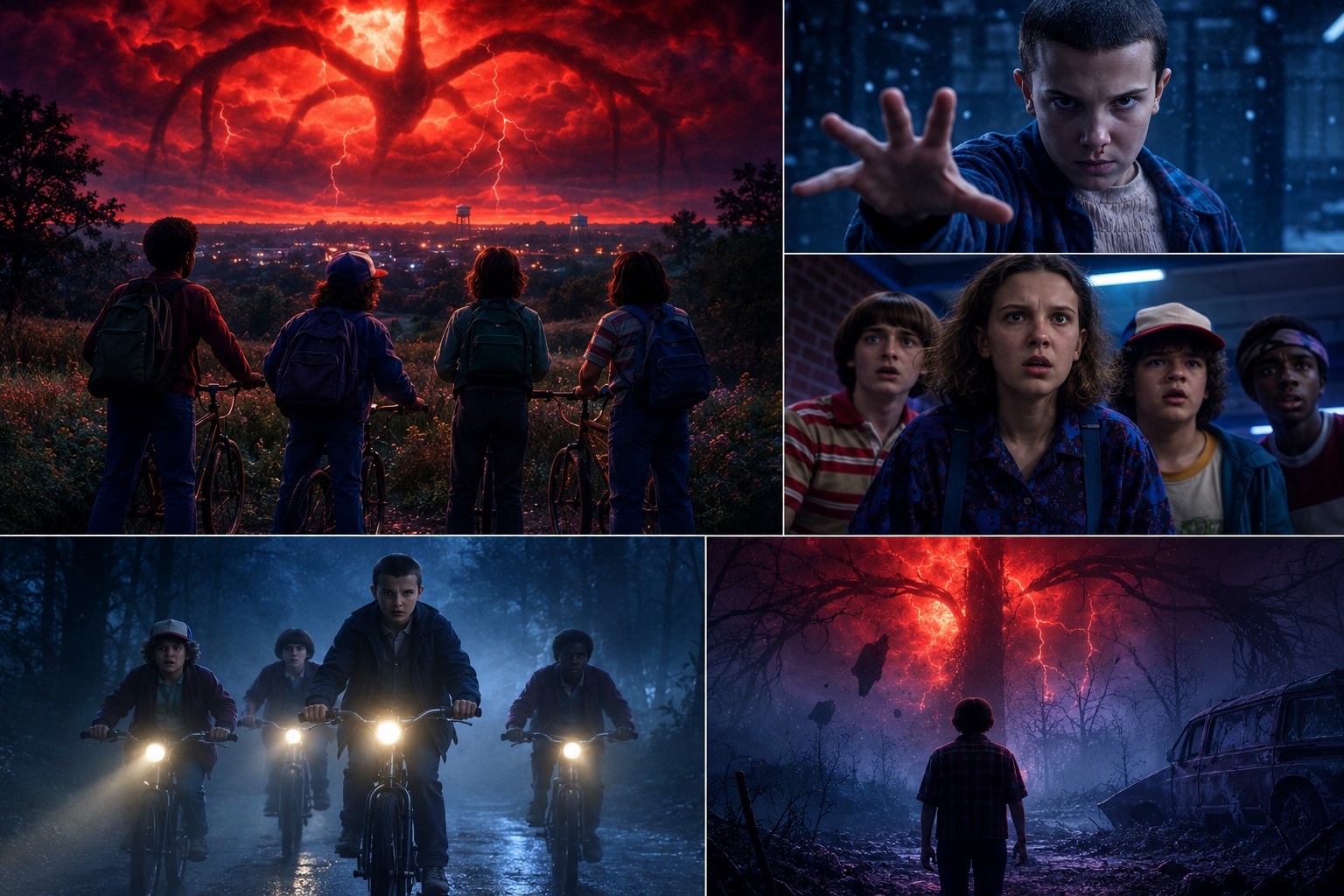

Every few years, television produces a show that stops being a show and becomes a shared cultural language, a set of images, sounds, and phrases that people who have never met can still use to understand each other instantly. Say “Upside Down” to a stranger on a train and you don’t need to explain yourself. Say “Should I Stay or Should I Go” and someone born in 2005 might hum along without ever having owned a Clash record. That is the specific, strange achievement of Stranger Things, the Duffer Brothers’ Netflix series that ran from 2016 to 2025 and, in the process, reshaped how streaming platforms think about scale, nostalgia, and the economics of a hit.
This piece isn’t a plot recap. It’s an attempt to explain, from first principles, why this particular show, about a missing boy in a town nobody had heard of, made by two relatively unknown filmmakers who’d been turned down by fifteen networks, became the thing it became, and what its nine-year run actually tells us about storytelling, risk-taking, and the economics of attention in the 2020s.
The Pitch Nobody Wanted
It’s worth sitting with a fact that gets glossed over in most retrospectives: Stranger Things was rejected by roughly fifteen cable networks before Netflix picked it up. Not because the writing was bad, but because the fundamental premise, kids as protagonists, embedded inside a horror-adjacent mystery aimed partly at adults, didn’t fit any existing shelf. Networks wanted it simplified in one direction or the other: make it a kids’ show, or cut the children out and follow the adult investigation. The Duffers refused both notes.

That refusal is the real origin story, more than the 1980s references or the synth score. The show’s entire creative identity rests on a structural bet that the industry considered commercially irrational: that audiences would tolerate, even crave, a serialized drama that moved fluidly between a child’s-eye view of wonder and an adult’s-eye view of institutional menace, without picking a lane. Netflix, a company that in 2015 was still proving that a streaming service could originate prestige content rather than just license reruns of Friends, was the only buyer willing to underwrite that bet at scale.
There’s a useful lesson buried here for anyone thinking about creative risk: the rejection wasn’t a signal that the idea was weak. It was a signal that the idea didn’t match the risk tolerance of the buyers being pitched. Netflix’s tolerance was different because its business model was different, a subscription flywheel that rewards distinctiveness and word-of-mouth over the safety of a familiar demographic quadrant. The show that resulted is, in a very real sense, a byproduct of a specific moment in media economics, not just a specific moment in the Duffers’ imaginations.
Why the 1980s, Specifically
It’s tempting to describe Stranger Things as “an homage to the 80s” and leave it there, but that undersells what’s actually happening structurally. The choice of period isn’t decorative, it’s load-bearing for the plot.
The series needed a monster that could plausibly originate from a government facility rather than a folk legend or a spiritual force, because the Duffers wanted the horror to feel scientifically grounded rather than supernatural in the classical sense. That requirement pointed them toward Cold War-era paranoia about clandestine government experimentation, a well-documented, real historical undercurrent involving programs like MKUltra, the CIA’s real mid-century mind-control research initiative that has since become public record through declassified files. Once you accept a covert lab doing psychic experimentation on children as a premise, 1983 becomes almost the only year that works: late enough that Reagan-era defense anxiety was fully mainstream, early enough that a show like Red Dawn (1984) hadn’t yet exhausted the “Soviet infiltration” anxiety as a pop-culture trope.
In other words, the decade wasn’t chosen because the Duffer Brothers were born in the 1980s and wanted to relive their childhood soundtrack (though that’s true too). It was chosen because the mechanics of the plot, a monster with a scientific origin story, hidden by a government agency, discovered by kids on bicycles rather than adults with security clearances, only cohere in a pre-digital world. Take away rotary phones and walkie-talkies and the entire structure of “kids solve the mystery before the grown-ups catch up” collapses, because a 2016-set version of the same story ends with someone texting a screenshot to the local news in episode two.
This is a broader principle worth naming explicitly: period setting, done well, isn’t nostalgia bait. It’s a mechanism for removing modern problem-solving tools (smartphones, GPS, instant search, surveillance cameras) so that human ingenuity, physical courage, and slow-built trust between characters have to carry the plot. Stranger Things understood this instinctively, and it’s the single biggest reason the show doesn’t feel dated the way pure nostalgia projects usually do within a few years.
The Structural Genius of Eight Episodes
Before Netflix, American television operated almost entirely on a 22-episode broadcast rhythm, engineered for advertising slots and syndication economics rather than storytelling needs. The Duffers have said publicly that they didn’t think a horror-mystery premise could survive that length without either padding the middle with filler or abandoning characterization to keep the scares coming. Netflix’s willingness to commission eight episodes for Stranger Things season one wasn’t a minor scheduling detail, it was the structural precondition for the show being good.
Eight episodes is long enough to build an ensemble cast with real interior lives (Mike’s loyalty, Nancy’s ambition, Joyce’s grief, Hopper’s guilt) but short enough that every episode has to earn its place. Compare that to a hypothetical 22-episode broadcast version of the same premise, and you can immediately see the problem: broadcast pacing would have forced the writers to either resolve the Will Byers mystery by episode six and spend the remaining sixteen on filler, or stretch the search across the entire season in a way that feels like padding rather than dread. The show’s now-famous “it feels like a movie” quality isn’t a style choice; it’s a direct consequence of episode count matching story need rather than ad-slot need.
This matters beyond Stranger Things itself. It’s part of a broader industry shift, one that shows like Breaking Bad and Mad Men had already begun on cable, and that streaming then generalized, toward treating a season as a single extended film rather than a string of standalone episodes. Stranger Things is one of the clearest, most commercially successful proofs of concept for that model, which is part of why its success mattered to the wider industry, not just to Netflix’s balance sheet.
The Cast: A Casting Director’s Case Study
Casting director Carmen Cuba’s work on this show deserves more attention than it usually gets, because the central creative risk of Stranger Things was always going to live or die on the child performances. Adult ensemble dramas can survive a weak supporting performance; a show built around four kids investigating a monster cannot survive even one child actor who can’t hold a scene.
The production reportedly auditioned close to a thousand young actors, using scenes from Stand by Me, Rob Reiner’s 1986 adaptation of the Stephen King novella, as the reading material, which tells you exactly what register they were hunting for: not “cute kid actor” delivery, but the naturalistic, slightly profane, emotionally unguarded rhythm of children who talk like real children rather than junior adults. Finn Wolfhard, Millie Bobby Brown, Gaten Matarazzo, Caleb McLaughlin, and Noah Schnapp all cleared that bar in ways that, in retrospect, look inevitable but at the time were genuinely uncertain bets, Netflix greenlit the series and began casting before the scripts were even finished, meaning some of what ended up on the page was shaped around what these specific actors could do, rather than the other way around.
The adult casting carried its own risk profile, just inverted. Winona Ryder hadn’t led a television series before and was, by her own account in multiple interviews, coming off a period where major studio leads weren’t being offered to her the way they had been in the 1990s. David Harbour had spent a career playing supporting villains and hadn’t been given a lead role of this size. Casting two performers who were, in industry terms, “undervalued” relative to their talent wasn’t just a budget-conscious decision, it fit the show’s entire thematic project of finding extraordinary stakes inside ordinary, overlooked people. Joyce Byers is explicitly modeled on Richard Dreyfuss’s obsessive, disbelieved protagonist in Spielberg’s Close Encounters of the Third Kind, a character everyone around her assumes is losing her mind. Ryder playing that role, at a moment when the industry itself had somewhat written her off, added a layer of resonance that no casting algorithm could have engineered on purpose.
Practical Effects as a Philosophy, Not Just an Aesthetic
The Duffers have spoken about wanting the show to scare audiences through mood and dread rather than gore, explicitly citing the Amblin Entertainment house style, Spielberg-produced films from the 1980s that used PG-13 restraint as a creative constraint rather than a limitation. That’s a specific, testable philosophy, and it shows up in a concrete production decision: wherever possible, the production built physical, practical creature effects (the Demogorgon animatronic, prosthetic work for later monsters) rather than defaulting to CGI, only falling back to digital effects for shots practical rigs genuinely couldn’t achieve in a compressed six-month filming schedule.
This isn’t a nostalgic affectation for its own sake, it’s a legible craft argument. Practical effects interact with real light, cast real shadows, and force actors to react to something physically present in the room, which tends to produce more convincing fear on camera than an actor reacting to a tennis ball on a stick. The show’s monsters, whatever you think of the later seasons’ increasingly elaborate mythology, consistently read as textured and physically “there” in a way a lot of contemporary CGI-heavy horror doesn’t, and that’s a direct consequence of a stated production philosophy rather than an accident of budget.
The Sound of Hawkins: Survive, Synths, and a Soundtrack Economy
Kyle Dixon and Michael Stein of the band Survive composed the original score, and the decision to hire them wasn’t incidental, the Duffers had been fans of the band’s earlier work on the 2014 film The Guest and reached out specifically because they wanted an analog-synthesizer sound indebted to John Carpenter and Tangerine Dream scores, rather than a conventional orchestral television score. That choice is now one of the most recognizable sonic signatures in television, instantly identifiable within two notes, and it demonstrates something important about scoring: a distinctive, constrained sonic palette (in this case, vintage analog synthesizers rather than a full orchestra) creates stronger brand recognition than a “bigger,” more conventional score would have.
The licensed music strategy is a separate, equally deliberate story. Needle-drops like The Clash’s “Should I Stay or Should I Go” in season one function as plot devices, not just mood-setting: a specific song choice that a character makes on a jukebox becomes a coded signal decoded by another character later in the same season. That’s a much higher bar than typical needle-drop usage, and it’s part of why Stranger Things soundtrack choices repeatedly triggered real chart resurgences rather than just streaming bumps: Kate Bush’s “Running Up That Hill” hit number one on the UK singles chart in 2022, thirty-seven years after its original release, directly because of its integral use in season four, and Metallica’s “Master of Puppets” saw a similarly dramatic streaming spike after its own pivotal season-four scene. Those aren’t marketing wins; they’re evidence that the songs were functioning as narrative information, which is a much rarer and harder thing to pull off than simply picking evocative period music.
What the Show Actually Says About Childhood, Trauma, and Institutions
Strip away the monster-of-the-week mechanics, and Stranger Things is fundamentally a show about institutional betrayal of the vulnerable, filtered through the lens of childhood friendship as the primary source of protection and repair. Hawkins National Laboratory is the government at its most literal, an entity that treats children as experimental material, discards inconvenient test subjects, and lies systematically to the town it operates inside of. Every season’s central conflict traces back, directly or indirectly, to that original institutional sin: Eleven’s captivity and experimentation, Vecna’s origin as a discarded and disfigured lab subject turned monster, and the recurring pattern of official cover stories (chemical leaks, containment drills) papering over supernatural harm caused by state secrecy.
Against that institutional menace, the show consistently locates safety and agency not in adult authority but in peer networks, the “Party,” in the show’s own Dungeons & Dragons-derived terminology. Kids trust each other before they trust parents, teachers, or police, and that trust is repeatedly validated: it’s Mike, Dustin, and Lucas who find Eleven and act on her information before any adult believes them; it’s the kids’ bike-riding, walkie-talkie network that outperforms the town’s actual law enforcement in the early investigation. This is a genuinely old narrative structure, you can trace it back through E.T., through King’s own It, through The Goonies, but Stranger Things is unusually explicit about tying it to a specific institutional villain (a covert lab under Department of Energy cover) rather than a vaguer sense that “adults just don’t understand.”
The show’s late-series decision to have Will Byers’s arc culminate in him coming out, after several seasons of the character’s sexuality being treated with visible narrative care but left unstated, extends that same thematic logic: institutional and social pressure (Hawkins, Indiana, in the 1980s, is not an accepting place) forces concealment, while the peer group, imperfectly, but genuinely, becomes the space where that concealment can eventually end. Critics writing about the final season’s handling of the storyline noted it as a meaningful, if overdue, culmination of character work that had been building since the character’s introduction in season one.
A Franchise Built the Hard Way: Stage, Animation, and the Limits of Extension
Most franchises of this size sprawl outward quickly and unevenly. Stranger Things has been comparatively disciplined about it, which is itself instructive. The prequel stage play Stranger Things: The First Shadow, which opened in London’s West End before transferring to Broadway, is a genuinely unusual choice of expansion vehicle, theatre is expensive, geographically limited, and impossible to algorithmically recommend the way a streaming spin-off is. Choosing it anyway signals that Netflix and the Duffers were willing to treat “prestige” and “reach” as separate goals rather than assuming every expansion needs to maximize subscriber numbers.
The animated spin-off, Tales from ’85, takes the opposite approach, broader reach, a different visual medium, aimed at extending the mythology to an audience that might not sit through eight hour-long live-action episodes. Together, the two projects show a franchise management strategy that’s segmenting audiences deliberately (theatre-going adults who want an origin story with theatrical craft; younger or more casual audiences who want an accessible animated entry point) rather than just multiplying the same live-action formula.
It’s also worth noting what the franchise has not done, at least not yet at scale: no confirmed live-action sequel series picking up immediately after the finale, no attempt to spin off individual characters into their own standalone shows the way some franchises fragment once the flagship ends. The Duffers have been on record wanting the story to have a definitive ending, nine years, five seasons, one core mystery resolved, which runs against the modern instinct to keep extending a hit indefinitely. Whether that restraint holds as Netflix continues to build out the franchise commercially remains an open question, but the choice to end the flagship series outright, rather than soft-rebooting it, is itself a data point about how much creative control the Duffers retained relative to typical showrunners on a hit this large.
The Numbers: What “Success” Actually Meant for Netflix
It’s easy to say a show was a hit; it’s more useful to look at what kind of hit it was and why that mattered to the business underneath it. Early viewership data, compiled by third-party measurement firms since Netflix didn’t originally disclose numbers, showed the first season pulling in some of the largest audiences the platform had seen for original programming at that point in its history, putting it in the same conversation as Orange Is the New Black and Fuller House for total reach. By the third season, Netflix reported the show had broken its own internal viewing records, with tens of millions of households watching within days of release.
What matters more than any single number is what those numbers represented for Netflix’s broader strategy. In 2016, the company was still actively trying to prove a thesis: that a subscription streaming service could originate must-watch television at a level competitive with HBO or premium cable, not just aggregate licensed content. Stranger Things became one of the load-bearing proofs of that thesis, a show recognizable enough to drive subscriptions on its own, prestigious enough to win awards attention, and rewatchable enough to keep generating engagement between new seasons. That combination is rarer than it sounds; plenty of shows achieve one or two of those three properties without achieving all three simultaneously.
The show’s awards history reflects that dual identity, genre spectacle taken seriously by prestige-television gatekeepers. Multiple Primetime Emmy nominations across acting, writing, and technical categories, Screen Actors Guild recognition for the ensemble, and Golden Globe nominations for its leads all point to an industry that, somewhat unusually for a horror-adjacent sci-fi show, treated it as a legitimate awards contender rather than a genre curiosity kept at arm’s length the way horror and science fiction often are during awards season.
The Fandom Feedback Loop
One of the more quietly remarkable things about this show’s run is how directly fan reaction shaped subsequent seasons, not in a cynical, focus-grouped way, but through a specific, well-documented case: the character of Barb, a minor supporting role in season one whose death was, by the Duffers’ own account, not originally intended to be a major story beat. Audience attachment to the character, expressed through hashtag campaigns and fan communities lobbying for acknowledgment of her death being treated seriously by the narrative, directly influenced how season two opened, with Nancy explicitly confronting the town’s indifference to Barb’s disappearance. That’s a rare, traceable example of a fandom’s emotional response becoming, in effect, a co-writer on a subsequent season, and it’s part of why the show’s relationship with its audience has always felt more reciprocal than most tentpole franchises manage.
The unusual commercial afterlife of specific props and consumer goods tells a similar story about audience investment translating into real-world behavior. Eggo waffles becoming a cultural shorthand for the show, entirely because they were established as Eleven’s favorite food, led Kellogg’s, a company that had no prior involvement in the production, to lean into the association after the fact, providing vintage advertising footage for Netflix’s own marketing. That’s the kind of organic brand entanglement marketing departments spend enormous budgets trying and failing to manufacture deliberately; it happened here because a specific narrative detail (a girl who’d been deprived of ordinary childhood pleasures gorging on waffles) resonated emotionally in a way nobody planned as a merchandising strategy.
The Uncomfortable Parts: Legal Disputes and Location Controversies
Any account of the show’s run that skips its controversies is an incomplete one. Filmmaker Charlie Kessler’s 2018 lawsuit alleging the Duffer Brothers appropriated ideas from his own earlier short film about Montauk, a real place with a genuine, pre-existing urban-legend history of alleged government experimentation that both projects independently drew from, proceeded far enough that a judge denied summary judgment in 2019, before Kessler withdrew the suit shortly before trial, reportedly after reviewing documentation showing the Duffers had developed their concept independently and earlier than his claim suggested. It’s a useful reminder that “based on a true urban legend” ideas can plausibly occur to multiple writers independently, given how widely circulated Cold War conspiracy folklore about Montauk already was by the 2010s, documented in books like The Montauk Project: Experiments in Time.
The more serious controversy involves the production’s 2022 use of Lukiškės Prison in Vilnius, Lithuania, as a filming location for season four. Jewish and Roma advocacy groups objected on the grounds of the site’s documented historical role during the Holocaust, criticizing both the choice of location itself and a subsequent tourism partnership that briefly rented out a Stranger Things-themed prison cell as short-term lodging. A petition drew over 60,000 signatures, and the rental listing was ultimately withdrawn. This is worth including not as a footnote but as a genuine tension inherent to location-driven, nostalgia-aesthetic production: filming in real places with real, sometimes atrocity-marked histories carries responsibilities that a purely fictional soundstage doesn’t, and the backlash here was a legitimate check on a production that, by its own scale, had enormous power to reshape how a real site gets marketed to fans.
What Comes After: The Hardest Trick in Television
Ending a hit show on its own terms, at a moment of the creators’ choosing rather than a network’s cancellation notice, is one of the rarest outcomes in the entire medium. Far more common is either premature cancellation before a story resolves, or the opposite failure mode: a show kept alive past the point its central mystery can sustain, diluting what made it distinctive in the first place. Stranger Things avoided both traps, ending after five seasons with its core mystery, what is the Upside Down, who is Vecna, can Hawkins survive contact with it, fully resolved rather than left open for a spinoff to exploit.
That discipline is itself the show’s most underrated legacy. In an industry environment where successful IP is almost reflexively extended until audience fatigue sets in, choosing to end a genuinely massive hit on a defined narrative terminus, while still building out adjacent, differently-scaled projects like the stage play and animated series rather than diluting the flagship itself, is a strategic choice that plenty of far less successful franchises would benefit from studying. It suggests a creative team, and a studio partner, willing to treat the story’s integrity as more valuable long-term than squeezing one more season of subscriber numbers out of a saturated premise.
The Villain Problem: Why Each Season Needed a Bigger Monster (and Why That’s Harder Than It Sounds)
Serialized genre television has a well-known escalation trap: if season one’s threat is a single Demogorgon, season two needs to feel bigger without simply repeating the same beat, and by season four or five the writers are cornered into either a franchise-ending cosmic threat or a noticeable dip in stakes that audiences read as fatigue. Stranger Things handled this escalation more carefully than most comparable shows by tying each new threat to the mythology established earlier rather than inventing an unrelated new menace from scratch.
The Demogorgon of season one is revealed, by season two, to be one biological expression of a larger “Mind Flayer” hive intelligence, meaning the second season’s larger threat isn’t a bigger monster bolted on for spectacle, it’s a deeper explanation of the first monster’s origin. By the time Vecna is introduced in season four as Hawkins Lab’s very first test subject, the show has quietly built a coherent internal history in which every antagonist across four seasons is causally connected to the same original institutional sin: Dr. Brenner’s experimentation program. That’s a meaningfully different writing discipline than the more common “monster of the season” approach used by many long-running genre shows, where each new arc’s villain has to be justified from zero. It’s also part of why season five’s finale, which required tying off Vecna, the Mind Flayer, and the Upside Down itself in a single conclusive act, didn’t feel like it was inventing a new solution out of nowhere; the pieces had been assembled patiently across nine years.
This is a genuinely difficult needle to thread in long-form serialized fiction, and it’s one of the more instructive lessons the show offers to other writers rooms: escalation doesn’t have to mean invention. It can mean excavation, revealing that the smaller threat you introduced years earlier was always a symptom of something larger, rather than discarding it for something unrelated and shinier.
Direction and Visual Language: The Duffers as Genre Translators
Matt and Ross Duffer direct a significant portion of the series’ most pivotal episodes themselves, and their visual grammar borrows deliberately and transparently from a specific cluster of filmmakers, Spielberg’s use of low camera angles to place the audience at a child’s eye level, John Carpenter’s use of negative space and static wide shots to build dread before a threat is visible, and David Lynch’s willingness to let a scene sit in unresolved tension rather than resolving it immediately for the audience’s comfort. What’s notable is that these influences are cited openly by the Duffers themselves in interviews rather than being something critics had to reverse-engineer, the show wears its reference points as a visible methodology, not a hidden source of anxiety about originality.
That transparency matters for how the show should be understood critically. Stranger Things was never trying to conceal that it was a synthesis project; its creative claim was never “nobody has done this before” but rather “nobody has combined these specific influences, at this length, with this cast, right now.” That’s a more modest claim than pure originality, but it’s also a more honest one, and it explains why the show reads as a coherent artistic statement rather than a random assemblage of Easter eggs, every reference is filtered through a consistent directorial hand rather than dropped in as isolated nostalgia bait.
The Merchandising Machine and Its Limits
A show generating this much cultural attention inevitably becomes a licensing business as much as a piece of television, and it’s worth being clear-eyed about that dimension rather than treating it as separate from the creative story. Target’s exclusive retail partnerships around season releases, the Eggo tie-ins, Coca-Cola’s limited-run New Coke revival timed to season three’s mid-1980s setting, a Dungeons & Dragons starter set built around the show’s fictional in-universe campaign, and an extensive line of collectibles and apparel collectively represent one of the more successful licensing operations built around an original streaming property, as opposed to a decades-old established franchise like Star Wars or Marvel that already had a built-in toy and collectibles infrastructure before its most recent screen adaptation.
What’s striking about Stranger Things merchandising, compared to more manufactured franchise tie-in campaigns, is how much of it traces back to specific narrative choices that weren’t originally designed as marketing hooks, Eleven’s Eggo obsession being the clearest example, a small character detail establishing a traumatized child’s simple, specific joy that only became a commercial asset after audiences had already emotionally attached to it. That’s a meaningfully different (and harder to replicate deliberately) path to merchandising success than a franchise designing toyetic elements into a script from the outset. It suggests that the most durable licensing opportunities tend to emerge organically from strong character writing rather than being engineered as marketing beats from a writers’ room whiteboard.
Influence on the Rest of the Industry
It would be an overstatement to say Stranger Things single-handedly caused the wave of 1980s-set and 1980s-referencing content that followed it across film and television, nostalgia cycles are broader than any one show, but it’s fair to say the show’s commercial success gave studio executives a concrete, recent data point to point to when greenlighting adjacent projects, from horror throwbacks to synth-heavy scores becoming a much more common choice for genre television generally. More significantly, its success helped validate a specific production model for other streamers: original, high-concept genre programming with film-level production values, released as a complete season rather than a weekly broadcast drip, aimed simultaneously at teen and adult audiences rather than being segmented into a children’s or adult slot.
That model is now so common across streaming platforms that it’s easy to forget how unproven it was in 2015 and 2016, when Stranger Things was in development. Competing services’ subsequent original genre programming, much of it explicitly compared to Stranger Things in early marketing and press coverage, owes a structural debt to the show having proven the audience and the model existed, even in cases where the resulting shows bear little direct creative resemblance beyond the genre category. In that sense, the show’s most lasting industry impact may not be its specific imagery or story beats at all, but the fact that it made a certain kind of green-light conversation easier for the next decade of streaming executives.
The Real Legacy
Nine years from a rejected pitch called Montauk to a finale watched by tens of millions of households is not, in itself, an unusual arc for a hit television show, plenty of shows run that long and reach that scale. What’s unusual is the specific combination of factors that got it there: a structural bet on episode count that broadcast television’s economics would never have permitted; a period setting chosen for mechanical narrative reasons rather than pure nostalgia; a casting process that prioritized naturalism over polish for its child performers, at real financial and schedule risk; a scoring decision that traded orchestral safety for a distinctive, constrained analog-synth identity; and a franchise-management philosophy that resisted the industry’s default instinct to extend a hit indefinitely.
None of those choices were guaranteed to work when they were made. Each one was, in its own way, a rejection of an easier, safer default, the kind of choice that fifteen cable networks had already signaled they didn’t want to fund. Understanding Stranger Things as a cultural phenomenon means understanding it first as a series of specific, risky craft decisions that happened to compound into something much larger than any single one of them, made by two filmmakers who, by their own account, weren’t even sure they’d get another shot at television after their first project barely got released at all.
That’s the actual “strange thing” at the center of the story: not a monster from another dimension, but an unusually stubborn insistence, at every stage of production, on doing the harder version of the idea instead of the easier one, and a streaming platform, at exactly the right moment in its own history, willing to bet on that stubbornness paying off.