

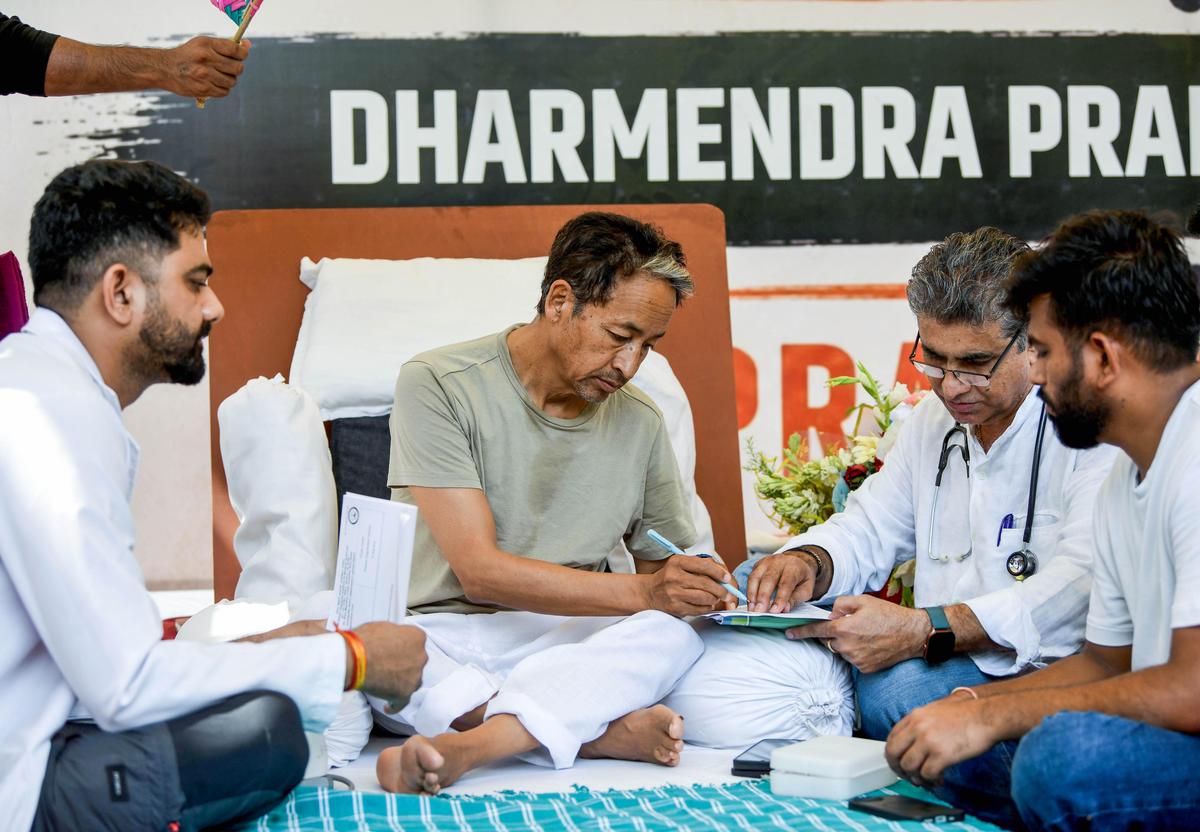

It is a hot afternoon in Delhi; at Jantar Mantar, the atmosphere is unbearably tense. Cars continue to pass through the barriers, people scramble to their offices, and life in the capital city continues at its fast pace. Yet, the situation at the protest site is different. Everything here is quiet, and the faces of the people are tense. Volunteers walk from one person to another, distributing water, while students sit tightly packed under tent-like covers with an aim to protect themselves from the relentless heat of the summer sun.
The protest is organised around a man. Sonam Wangchuk has been fasting for nearly three weeks. This educationist, innovator, and environmental activist gained international prominence due to his work in the realm of sustainable education and environmentally friendly engineering. However, the man has chosen a hunger strike as his form of protest. The poor health of Sonam Wangchuk is the topic of conversations.
But Wangchuk holds onto his position. Those who know him well have said that he has made it clear from the beginning that he doesn’t want any kind of sympathy. He wants only a dialogue. The indefinite hunger strike that he started on June 28 has been receiving a lot of attention due to the controversies regarding the NEET-UG exam and other competitive exams. Wangchuk wants, along with the resignation of the Union Minister of Education, Dharmendra Pradhan, accountability on the aforementioned issue. However, according to him, the matter is not just about one examination. Wangchuk and the people supporting him in the protest believe that what is important is restoring faith in the school system.
No matter what people think about his approach, it has become more than obvious now that the protest that started with one person in the beginning has already attracted the public’s attention.
After spending a few hours at Jantar Mantar, it becomes evident that this gathering doesn’t comprise people who belong to the same political group. Instead, each person has come here with a different story that explains what brought them there, as well as their concerns. There are people such as students taking their competitive exams and parents who have watched their children put years into this tedious process.

There are common citizens who want to raise their voices about such a serious matter as the problems of examinations. Slogans are chanted throughout the gathering, but the true emotions are often expressed during the hushed conversations. For instance, one student shared that he has been preparing for years, believing that success lies in hard work, while another student explained that her coaching classes gave her serious pressure and that she sacrificed a lot financially. A parent thought out loud about what it means when exam scandals happen regularly for children who believe that only merit will help them.
The same word comes up again and again in their conversations. Trust. Trust in fair examinations. Trust in transparency of institutions. Trust in fairness for all students regardless of the pressure exerted. Generally, this demonstration is not only about one examination paper or one instance of mishandling by the government. It is about restoring one’s faith in a system that affects millions of people. But as Wangchuk launches into week three of his hunger strike, worries over his wellbeing enter into the larger picture. The doctors have expressed fears regarding serious muscle depletion with fasting due to lack of food.
Anxious supporters circle him, desperately wondering how to convince him to stop the protest. Meanwhile, others are raising the question to the government. If demands require discussions, the question arises: why is there no productive communication?
The question has become one of the key issues in the protest. Nonetheless, there is a belief among some of the supporters that Wangchuk is on his protest not for the sake of his own personal gain or political career, but for the sake of raising awareness about pressing issues in the educational system of India. Thus, the supporters think that when peaceful protests and public invitations fail, hunger strikes are a method of last resort. Thanks to this belief, the public has shown no weak willingness to help Wangchuk.
Within the past few days, various people like film stars, movie makers, screenplay writers, professors, and public figures have raised their concern about Wangchuk’s health. They may differ in their political opinions, but they all have one basic demand in common: that the authorities should consult with Wangchuk so that no harm is done to either side.
Among those who spoke out, we find actress Sonakshi Sinha, who revealed in her interview that she seldom speaks in public on political affairs, but she could no longer tolerate Wangchuk’s struggle. Sinha’s video on social networks was more focused on the issues of morality than on the problem of politics.
She reminded the spectators that Wangchuk is a person who has played a considerable role in the field of knowledge and technology, and it is ignorant of our society that a man has gone on hunger strike because of his conviction that the students of this nation ought to receive a better education. Sinha posed a question to the public: “What is the reason for the inertia of our society when it comes to negotiations on such a controversial matter?”
The fight was close to Sinha’s heart even though she had never met Wangchuk in person. “He may not know who we are,” said Sinha, “but it talks about a man risking his life for the welfare of the children of this country”.
This sparked conversations on social media, where many echoed similar sentiments. However, this was not the end of the story. Aditi Rao Hydari joined in, affirming that even though political differences exist, the most important thing is to have empathy. Dia Mirza took a more subtle approach, urging people to show their support to those who fight for children through a simple message. Shabana Azmi went as far as to appeal to Wangchuk himself, urging him to end his fast, stating that the country needed him to live and continue the fight.
While the involvement of such prominent personalities has increased the popularity of the protest, in Jantar Mantar itself no such concerns could be seen around.
Conversations take place at regular intervals regarding the same problems. Students. Exams. Accountability. While more and more people are getting convinced that India’s education system cannot survive without public faith. As night is falling and people are settling down, some of them are getting ready to spend one more night camping, others are developing plans for future actions. Volunteers are communicating with people fasting in solidarity, and reporters are talking to interviewees, making enquiries about the situation.
For the time being, Sonam Wangchuk is sitting there in the same position for several days. He says very little. His supporters keep speaking on his behalf, though. Also, the longer his hunger strike lasts, the more noise surrounds him.
After three weeks into the protest, the narrative of what was happening at Jantar Mantar was no longer just about Sonam Wangchuk’s fast. Though the fast was a very integral part of the protest, there was another narrative building around it, driven by the students and youth who felt they were finally given a chance to voice their concern. The movement, which started as one man’s protest, gradually turned into a wider issue concerning the education and future of young people in the country.
While walking around the protest venue, the diversity present in the crowd couldn’t be missed. Students, parents, teachers, researchers, professionals and activists were all sitting together. Some of the people had come from nearby states after travelling through the night, while others had taken leave from work and colleges for a couple of hours. There were no fancy stages or political gimmicks in sight. Rather, people were being served water, and volunteers were organising food and helping with medical assistance.
Many of those present maintained that they were not there to engage in party politics. They labelled themselves as ordinary citizens who felt the need for someone to understand their viewpoint on the underlying issues in India’s educational system. The exchanges were punctuated by continuous focus on similar themes – fairness, transparency, and trust. Although individual experiences differed, they all expressed similar discontent. For many speakers at the gathering, it was not just about a particular exam or controversy, but justice in a huge university system affecting the futures of countless young Indians.
Ashutosh, one of the main activists in the movement, was among those who spoke at the rally. He talked to reporters and explained that the campaign is rooted in the desire to make the system accountable. “We are fighting for the youth of this country to be heard," he remarked, emphasising that what prompted the rally was more than a simple controversy over exams. He believes that the problems of students start long before they are faced with the competitive exams, since they originate in schools, colleges, and the areas of skill development and job searching.These issues are connected in Ashutosh’s opinion, and represent larger structural problems of the educational system.
While acknowledging that the first demand of the group is the resignation of Education Minister Dharmendra Pradhan, whose political responsibility has been cited by the organisers as the reason for failures in the education system, the speaker also pointed out that the movement does not stop there. “Our primary demand is resignation, but our main goal is to reform education,” the speaker said, adding that the organisation has already issued a charter of demands concerning reform to the examination system and intends to consult with students, teachers, and other stakeholders prior to presenting a more detailed action plan.
At the event held during the day, speakers affirmed that the movement spun out of a much larger set of issues rather than one single incident. They claimed that their goal was to bring light to challenges that have been existing in the educational sphere in India for years. Judging by the responses of the protest participants, this message was well received.
One of the speakers observed that whenever there is a controversy about test integrity, students start losing their trust in the educational institutions that they had been relying on. Despite achieving some success in spreading their message, the movement has faced criticism from the sceptics. Some individuals argued that the protests are just noise that is going to die out in a week. The protest organisers claim that they have denied this possibility. Almost a month later, Jantar Mantar demonstrates similar crowds that came to support the cause in the first protest.
The supporters expressed similar views. Some communicated that they travelled hundreds of miles just to protest alongside others for a few hours. Others would come repeatedly as they believe being physically present at Jantar Mantar is equally important, in addition to spreading awareness online. Even though the heat of the summer in Delhi was overwhelming, followed by heavy showers for days, the protest was uninterrupted. The participants remained on the spot, continuing to raise their demands, while the volunteers adapted to the weather conditions.
“We have not moved even a bit,” Ashutosh claimed, showcasing the survival of the movement as evidence of its determination.
When the perspective on the next steps of the movement was raised, the organisers were confident that the struggle would go on irrespective of whether their demands would be met. When asked what would happen if the government failed to respond, Ashutosh said that the movement has claimed its independence already. He said that the movement would continue its actions, regardless of the political decisions.
Organisers also disclosed intentions to hold a peaceful march towards Parliament, stating that Parliament is meant to serve the people and should thus be open to hear their problems in a democratic manner. They denied allegations made on social media that their movement was run or financed by political groups. They say that the movement consists of students and concerned citizens whose concerns relate to education reforms and accountability. Whether their explanations amuse their critics is another question, but the organisers are firm in saying that their goal has remained the same from the very beginning, which is to start a meaningful discussion on the future of education in India.
As evening approached in Jantar Mantar, there were hardly any signs that the protest was coming to an end. Their volunteers were getting ready for another night under makeshift tents, reporters were interviewing participants, and students were forming small crowds to discuss various issues like exam reforms and job opportunities. Meanwhile, Sonam Wangchuk stayed sitting, carrying out what had become a symbol of the movement—his hunger strike.
People who were there with him called it perseverance, responsibility and optimism. The actions had already taken the form of more than one investigation process or just the minister. It became a bigger deliberation about the question of the perceived voice of the youth of India.
With each passing day, the protest of Sonam Wangchuk started to reach people beyond Jantar Mantar. Videos of the incident were all over social media. Several pictures of the teacher, who looked bad after weeks of fasting, circulated on the Internet numerous times. Different TV news programs delivered information about his health condition, while the talks that started with students expanded to their apartments, workplaces, etc.
Therefore, the movement attracted many people from different fields like cinema, literature, economics, public life, etc.
One of the first singers to get much attention was an actress Sonakshi Sinha who said that she had never made any public statements before. Sinha spoke about how her heart was breaking so she could not keep silence any longer.
She pointed out to the crowds that the individual was known amongst the knowledgeable individuals for his efforts for the education as well as innovation sector and now had abstained from eating since a number of days not selfishly, but for the reason that he thinks that the students need better chances for future. The aforementioned person was struggling for the individuals whom he does not know personally, though they have invested their energy and enthusiasm in examination preparations and their families have spent all their possessions for those aspirations.
Sinha was concerned about why there seemed to be no meaningful communication, although the person’s state of health continued to worsen. Instead of requesting him to stop his fast, the girl tried to talk to the authorities, saying that it would be good if they listen to the problem before it is too late. Her words were properly transmitted over the Internet, and thousands of people shared the video expressing similar thoughts: what can we do if peaceful protests are ignored? A well-known actor also expressed her support for this person. She said that even if there are political disagreements in a democracy, compassion must never disappear from the public.
The actor and eco-warrior Dia Mirza used a more subdued yet potent means of rallying support. In a modest social media post, she called upon people to “stand behind those who stand for our kids.” It may have been an extremely short sentence, but it actually sums up the thoughts of most of the supporters who think that it is really the future of the
kids that is at the centre of Wangchuk's protest.
Famous film star Shabana Azmi, who praised Wangchuk’s insistence on his beliefs, also made an emotional plea and urged him to end his hunger strike. According to her, the country needs him alive and healthy in order to keep fighting for the issues he believes in. Azmi’s message is in line with the thoughts of many supporters who agree with the goals of the protest, but are concerned about the toll it is taking on Wangchuk’s health.
Actress Soni Razdan responded in a very emotional manner by not writing a statement, but coming up with a poem in which she begs Wangchuk to “live to fight another day.” It came with a straightforward message: “We’re counting on you. Stay with us.” The poem soon spread online and became yet another reminder of how public worries regarding Wangchuk’s health had started to eclipse the actual political discourse.
Filmmaker Anurag Kashyap chose to take a more straightforward approach. Calling Wangchuk a “braveheart,” he condemned what he thought of as government silence during the ongoing protests. Kashyap said that it was disturbing enough to be quiet when the activist is going through an indefinite fast regarding issues dealing with students.
Singer and composer Vishal Dadlani, who was travelling in the United States at the time, recorded a video message expressing support for the protesters. He apologised for being unable to reach Jantar Mantar physically and described the protest as a fight for students’ rights rather than political power. Two appeals were made. The first appeal was directed at Wangchuk and called upon him to stop his fasting since his life was very valuable. The second appeal was directed at the government, imploring them, “Please listen.“
Dadlani argued that the movement was not calling for a governmental change rather was seeking answers regarding students and education. The central point was the need for the safeguarding future generations in the country. Actor Fatima Sana Shaikh raised concern for Wangchuk’s deteriorating health and expressed her support for the cause. Prior to her, actor Swara Bhaskar had shown her support by visiting Jantar Mantar to appreciate Wangchuk’s efforts. Numerous people from the film industry and the education sector joined the protest, expressing their support for Wangchuk.
While the increase in support from celebrities may have helped raise the issue from a niche one into national relevance, the organisers persisted in the belief that the protests were not about the celebrities who endorsed the campaign. What mattered most was the group of students sitting silently under awnings at Jantar Mantar.
They were the ones who, in the opinion of the organisers, represented a crucial aspect of the protests. While the protests kept going from one week to another, one question loomed above all others.
What is next? Will a dialogue commence? Will the demands get a response? Will the hunger strike be called off before Wangchuk is in critical condition? Nobody on the site seemed to have answers to these questions. One thing is for sure though: the talks had already gone way beyond Delhi. There were discussions happening everywhere online and offline, including social networks, campuses, tutors’ offices, and even dining tables. And this might explain why this campaign has resonated with so many people.
This is because what has now become a symbol has helped thousands of others express worries they have been holding for years. For some, it is about anger towards a system they think is in need of reform. For others, it denotes belief that democracy becomes stable not only thanks to elections, but also due to the ability to talk to each other, to be disagreeable and to listen. It is hard to say whether the protest will achieve its goals. Changes in policies usually take place very slowly. Social movements rise and fall, while political discussion continues even when the news is gone.
Anyway, regardless of what happens next, Wangchuk is successful in what many protests fail to do. It has triggered a national dialogue.
It unites students, teachers, parents and members of the creative class. It reminds us that behind every exam and every policy decision there is a person whose future depends on our institutions. And as the night came in Jantar Mantar one thing kept on representing the movement. Neither speeches. Nor slogans. Neither news headlines. But a man who has become weaker every day of his protest, whose signal was quietness itself.
References
- Reuters. Fasting Indian activist shifted to hospital, police say. (18 July 2026)
- The Indian Express. Sonam Wangchuk to Express: CJP protest has no political colour, PM should be sensitive. (14 July 2026)
- The Indian Express. Sonam Wangchuk down 9 kg on Day 19 of fast, says ‘don’t ask me to give up’. (16 July 2026)
- The Indian Express. Delhi High Court directs medical monitoring of Sonam Wangchuk during hunger strike. (16 July 2026)
- The Indian Express. Congress urges Sonam Wangchuk to end hunger strike. (16 July 2026)
- The Indian Express. Opposition parties rally behind Sonam Wangchuk as protest continues. (17 July 2026)
- National Testing Agency. Official Notices and Press Releases on NEET-UG. (For official statements and exam updates.)
- Ministry of Education. Official statements regarding NEET-UG and examination reforms.
- Supreme Court of India. Judgments and proceedings related to NEET-UG 2024 examination petitions (if you mention court developments).
- Reuters. Coverage of the NEET examination controversy and related protests.
- Press Trust of India. Reports on Sonam Wangchuk’s hunger strike and public reactions.
- The Hindu>. News reports covering NEET-UG, student protests and Wangchuk’s hunger strike.
- The Indian Express. Coverage of examination controversies and protest developments.
- The Times of India. Reports on Wangchuk’s fast, NEET-UG developments and reactions.
- NDTV. Coverage of the protest and celebrity reactions.
- India Today. Reports on the hunger strike, examination controversy and interviews.
Verified public statements and social media posts by:
- Sonakshi Sinha
- Aditi Rao Hydari
- Dia Mirza
- Shabana Azmi
- Anurag Kashyap
- Vishal Dadlani
- Swara Bhasker
- Sonakshi Sinha
- Aditi Rao Hydari
- Dia Mirza
- Shabana Azmi
- Anurag Kashyap
- Vishal Dadlani
- Swara Bhasker
Author's Note: This feature is based on publicly available news reports, official statements, interviews, and public reactions available at the time of writing. Statements attributed to protesters, organisers, public figures, or government representatives reflect their respective views and should not be interpreted as independently verified findings.